
Published: : June 19, 2026, 11:43 AM
Writing this, I’m reminded that until I was quite old I too adhered to the romantic cult of madness. I got over it, thank God. Experience has taught me that this particular form of romanticism is pure stupidity, and that madness is the saddest, most dismal thing on earth. – Emmanuel Carrère, Limonov.
It does not begin with power. It begins with a vacuum. With a country that no longer understands itself, and with men who believe they recognise their opportunity precisely in that. The Wizard of the Kremlin by Olivier Assayas is not a film about Vladimir Putin in the strict sense. It is a film about the invention of power and about those who believe they can control it, until they themselves become part of their own illusion.
Assayas, who already demonstrated in the mini-series Carlos how political biographies can become feverish portraits of an era, tackles a far more diffuse subject here. Together with Emmanuel Carrère – whose view of figures such as Eduard Limonov is always also a glimpse into moral abysses – he has developed a screenplay that circles around rather than narrates. Truth here is never stable, but rather an effect of staging.
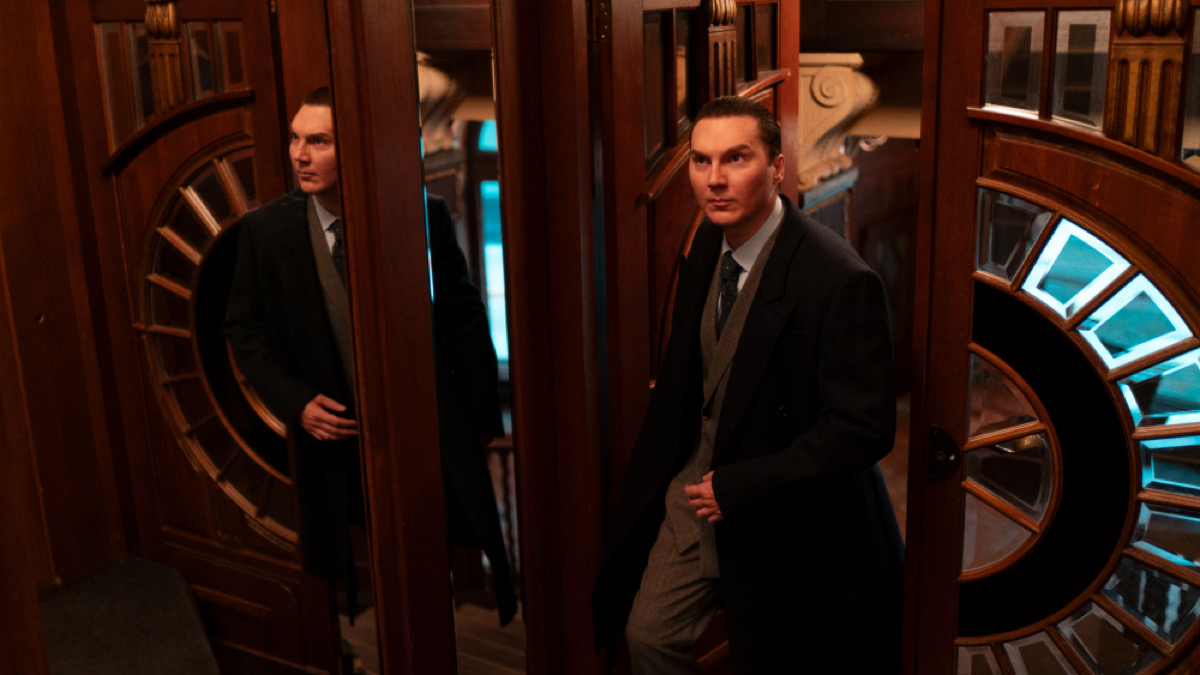
At the centre is Vadim Baranov, played by Paul Dano, a man who, emerging from the post-Soviet chaos, does not simply build a career, but constructs a stage on which reality itself becomes a spectacle. It is no coincidence that Baranov is unmistakably reminiscent of Vladislav Surkov. He is the "wizard" who believes he can control narratives until they begin to take on a life of their own.
Jude Law as Putin is one of the film’s great surprises. Not because he imitates, but because he plays a void, a projection screen. His Putin is less a character than a function: a condensation of power, as subtle as it is crude, that feeds on the weakness of others. In doing so, the familiar iconography of power is cleverly subverted, revealing instead just how much power depends on those who enable it.
It is clear that the film is based on Giuliano da Empoli’s novel, though not as a mere adaptation but as an intellectual framework. The idea of the ‘Tsar’ and his ‘Rasputin’ is not a historical reference here, but a diagnosis: No despot rules alone. There are always those who invent, promote and legitimise him. And who are deluding themselves in the process.
The film is at the same time a sobering critique of the West and its self-image of supposed freedom, which it relishes in displaying – a fact that likely also explains the lukewarm reception from the Anglo-American and German press at the premiere in Venice in 2025. This is the “cinema of the new reality” that festival director Alberto Barbera proclaimed there, and which does not necessarily fit with the “woke” reality of our present day, because it questions current conditions from all sides and is not always “politically correct”.
For at some point, even in Assayas’ film, the ‘circumstances’ shift. Too much freedom leads to chaos. The manipulated figure develops agency; the puppet-master becomes an extra in his own production.
Assayas’s adaptation is at its strongest when he depicts precisely these shifts: the subtle, almost imperceptible moments in which control turns into a loss of control. When Baranov realises that his system not only manipulates but also reproduces itself; that truth and lies can no longer be distinguished because both have become part of the same dramaturgy.
Read this way, The Wizard of the Kremlin is neither a pessimistic nor a nihilistic film. It is too lucid for that; rather, it possesses something of the crystal-clear, merciless clairvoyance of Hans Christian Andersen and his Snow Queen. It shows that the dream of a free Russia was destroyed not only from above, but also from below; by a society in which freedom itself became a scandal, an overwhelming burden, a catalyst for a new authoritarian reflex.
Formally, Assayas remains controlled and cool. The images avoid pathos, relying instead on a steady intensification of atmosphere. The fact that all the actors speak English for production reasons could easily have led to artificiality, but here it functions as a deliberate distancing – for this story is not merely Russian, but universally accessible.
Not everything told here, however, sustains interest over the full running time. At 154 minutes, the film is occasionally a little too long; some dialogue repeats what has long since become apparent. A bit of trimming would have done it good here, not to reduce the complexity, but to sharpen its impact.
Nevertheless, The Wizard of the Kremlin is a remarkably precise, intelligent film. One that does not view politics as a sequence of events, but, like its protagonist, as an aesthetic system. As a game. As the ultimate fun, as it is once put. And therein lies its unsettling truth. For what Assayas shows us at the end is perhaps the most unpleasant, the most perfidious and the most hopeless thing that can be said at all in the face of our current global political discord: power does not come solely from above, but arises from an interplay of desires, projections and narratives, which also mean that those who believe they control it are often merely its first victims. And what follows can be compared to what Hannah Arendt once described as the banality of evil. In Assayas’s work, it is the cementing, the becoming part of everyday life, of this banality.