

Published: : September 13, 2026, 12:31 AM
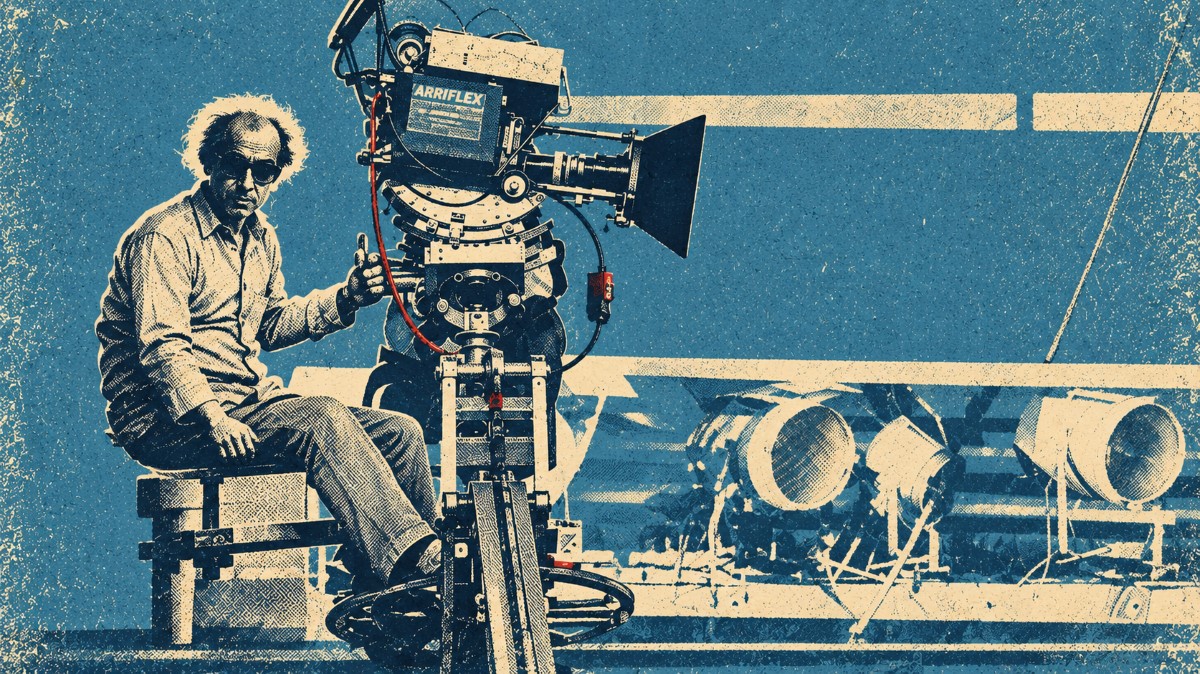
My first Godard film was Breathless (1960), which I watched during the pandemic while I was studying cinema intensively. I felt almost no distance from the characters. The film was abrupt, unpolished and honest about its people’s contradictions in a way few films I’d seen before had been. Nowhere is that honesty sharper than in the film’s hotel-room sequence. It externalizes Patricia’s conflict between her intellectual desire for independence and her visceral pull toward Michel’s chaotic gravity. She asserts a need for freedom even as she doubts her own love, while her eventual physical surrender is undercut by her wide, unblinking eyes - a mind still at war with itself. Godard sharpens her instability further through erratic, disjointed jump cuts that echo her anxious pacing and through a small, strange gesture: she rolls up a poster. She holds it to her eye like a telescope, artificially distancing herself from Michel even as she stays in the room with him.
That scene is often read as a portrait of one character’s inner conflict. Critics have argued over exactly what the jump cuts mean since the film premiered. Some, like Luc Moullet, saw the fragmented editing as a structural echo of Michel’s own moral discontinuity. Godard was once asked directly if the cuts captured his characters' psychology. He said no. But he added that he wouldn't have cut a calmer story the same way. That's a real contradiction. And it's telling. Even Godard couldn't give a clean explanation for his own instincts. So it's worth widening the lens here. The fractured editing was never just a psychological device.
It was one expression of a much larger, career-long refusal - the refusal to let cinema pretend.
Traditional filmmaking relies on narrative transportation. The careful engineering of sound, image, and editing has always pulled the audience into a state of suspended disbelief. Godard treated that seamlessness with suspicion. Mainstream cinema works hard to hide the apparatus it creates. Godard believed that pretending a film “real life” was dishonest. So he deliberately broke the illusion, keeping the audience aware they were watching something constructed rather than something lived. He violated foundational rules of visual grammar, like the 180-degree rule and standard shot-reverse-shot coverage - sometimes filming only the backs of his characters’ heads while they spoke. The goal wasn’t confusion for its own sake. It was to keep the viewer intellectually alert and critical.
Godard, who started as a fiercely opinionated film critic for Cahiers du Cinéma, believed that mainstream studio cinema had become rigid, predictable, and dead. By intentionally violating the rules, he wasn't just making a movie; he was performing an act of rebellion. He viewed traditional cinematic rules as arbitrary handcuffs, once noting that he deliberately wanted to explode conventions to see what could be built from the ruins. If the establishment called his methods a mistake, Godard took it as proof he was shaking them up.
This instinct for honesty over illusion began as much out of necessity as philosophy. On Breathless, Godard couldn’t afford a camera dolly. His cinematographer, Raoul Coutard, was pushed through the streets of Paris in a wheelchair to get the film’s now-famous tracking shots. What began as a budget workaround became a signature: handheld and openly imperfect. That same restlessness soon turned toward genre itself. Godard labeled A Woman Is a Woman (1961) a “neo-realist musical,” fusing the artifice of a Hollywood musical with the grit of documentary-style filmmaking. In Alphaville(1965), he shot a science-fiction future without building a single futuristic set. He used the unmodified architecture of 1960s Paris to suggest that the dystopia was already here, hiding in plain sight.
The same impulse appears in his use of dialogue and sound. Godard often treated speech as its own material, meant to provoke rather than advance a plot. His characters frequently break the fourth wall. They stared into the lens as though acknowledging the artificiality of their own existence. In 2 or 3 Things I Know About Her (1967), this reaches an extreme: over a screen-filling macro shot of a swirling cup of coffee, Godard overlays his own whispered monologue questioning the nature of existence, observation, and consumerism. He detaches the spoken word from character entirely, turning the scene into something closer to direct transmission than dialogue, as if he were going back and forth between voicing thoughts and abstractions. The jump cuts, the wheelchair dolly, the genre mashups, the coffee-cup monologue- this is a continuous argument about becoming unorthodox in approach.
A film owes its audience honesty about its own construction, even when honesty costs comfort. By the late 1960s, that instinct had hardened into something closer to a political stance. Godard grew hostile toward commercial cinema and the capital that funded it. But the root of it never changed. We live in a different era now, where every frame can be smoothed and color-graded into something flawless before anyone sees it. Godard staked a career on the opposite belief. The little technical nuances were where the truth lived. So the question worth asking is simple - in our rush to make everything look clean, are we polishing away the very imperfection that made it feel real?
Mohammad Tasawar Islam is a documentary photographer and visual artist based in Dhaka, Bangladesh.
Send your reviews, articles, and pitches for Cut to Cinema to [email protected]. Check out our submission guidelines for more details.




-C2C-20260906052400.jpg)