

Published: : September 15, 2026, 12:32 AM
For a Bengali, a river is never merely a body of water. It is a state of mind. Our stories, migrations, griefs and survivals are all tangled in river silt.
When Manik Bandopadhyay wrote Padma Nadir Majhi, the river was more than a workplace for fishermen; it became a force of nature—ruthless, seductive and indifferent to human hunger. In Bibhutibhushan Bandyopadhyay’s Ichhamati, the river takes on a quieter, more ancient presence, witnessing the decline of indigo factories and the passing lives of generations of ordinary villagers.
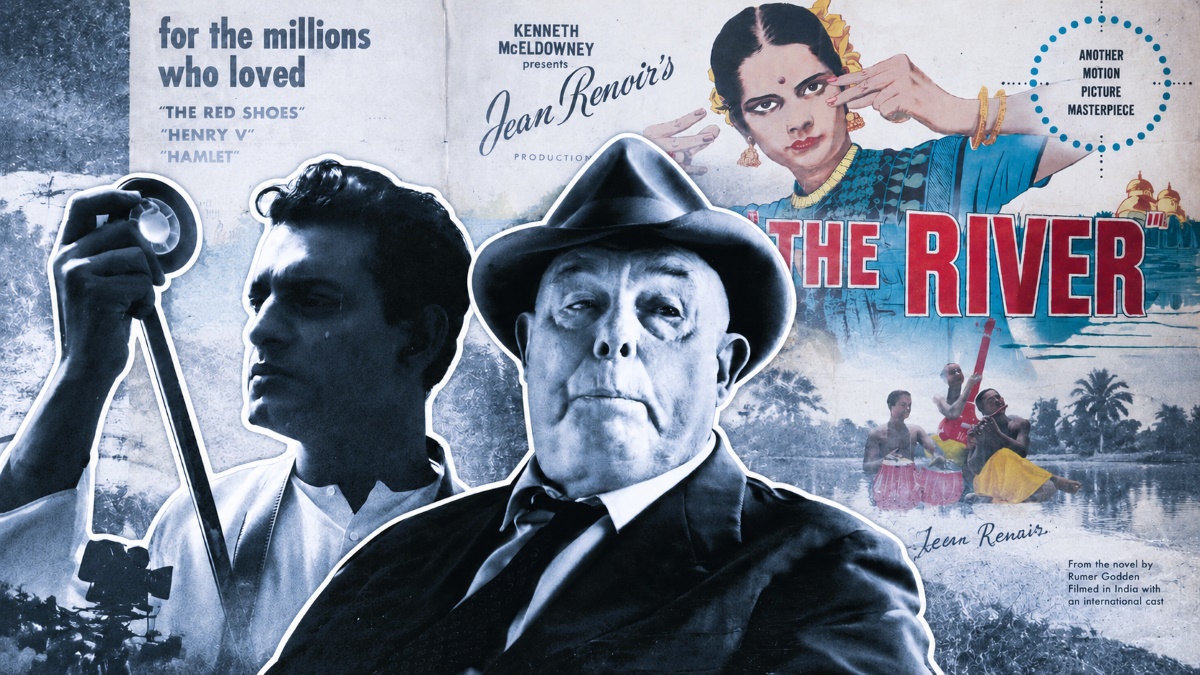
This deep cultural intimacy with rivers may explain why Jean Renoir’s 1951 film The River continues to hold a particular fascination for Bengalis. But most of us do not encounter Renoir’s Technicolor film through European film clubs or repertory screenings. We come to it through a more personal and historic connection: Satyajit Ray.
In his memoirs Our Films, Their Films and Bishoy Chalachchitra, Ray recalled Calcutta in the winter of 1949 with particular fondness. He was then 28, working as a layout artist at an advertising agency and increasingly frustrated with Bengali cinema, which he felt was weighed down by melodrama, theatrical performances and artificial studio lighting. Around this time, Jean Renoir arrived in Bengal to make The River, adapting Rumer Godden’s novel of the same name. Ray immediately sought him out.
Over several weekends, Ray accompanied the ageing French filmmaker through the rural outskirts of Barrackpore as Renoir searched for locations. He watched not only what Renoir chose to film but how he looked at Bengal—the bamboo groves, mud houses, riverside paths and, above all, the faces of ordinary people. During one of those walks, Ray told Renoir that he wanted to make a film based on Bibhutibhushan’s Pather Panchali. Yet he was unsure whether such a quiet story about an impoverished rural family, with little conventional plot, could hold an audience without songs, dances, melodramatic villains or elaborate studio sets.
Renoir encouraged him to trust what was already there. His advice, as Ray later recalled, would become an important influence on his approach to filmmaking: look at natural light, look at people, and do not embellish what is already there. If life on screen feels authentic, the audience will stay with it.
The encounter would have consequences far beyond Ray himself. The making of The River brought together several people who would soon help shape the visual language of Indian cinema. Bansi Chandragupta, who worked as an art assistant on Renoir’s production, gained experience in creating environments that felt lived-in rather than constructed. He later brought that sensibility to the crumbling ancestral home in Pather Panchali. Subrata Mitra, then an inexperienced young man observing Claude Renoir’s cinematography, absorbed lessons about naturalistic lighting that would eventually contribute to his pioneering use of bounced lighting in Aparajito. In that sense, The River became part of the story of how a new kind of Indian cinema began to take shape.
Watching the film today, it is easy to understand what Ray and his contemporaries may have found so liberating in Renoir’s approach.
Set around a British jute mill on the banks of the Hooghly, The River follows three young women—Harriet, a shy poet; Valerie, an outgoing visitor from England; and Melanie, their Anglo-Indian neighbour—whose lives are unsettled by Captain John, an American war veteran who has lost a leg. All three become infatuated with him, but Renoir is less interested in a conventional love triangle than in the idea of change. The film repeatedly returns to the Heraclitean notion that we cannot step into the same river twice, while the lives around the characters continue in their own rhythm: boatmen sing bhatiyali, workers carry jute, women wash clothes and children play by the water.
That indifference becomes devastating when Harriet’s younger brother, Bogey, is killed by a cobra. Renoir refuses melodrama; the boy lies still in the grass as the snake disappears and life carries on around him. The tragedy is powerful precisely because the world does not stop for it. The characters, too, are negotiating their own forms of loneliness—Harriet wants to be recognised as an artist, Valerie learns that desire is not the same as understanding, and John seeks comfort in the admiration of the girls while trying to escape his own wounds.
Melanie, played by Radha Burnier, is perhaps the film’s most complex figure. The daughter of a British father and an Indian mother, she lives between two cultures. When John looks to her for an idealised form of Eastern spirituality, she resists, recognising the tendency of Western visitors to romanticise India as an escape from their own troubles. Her Bharatanatyam performance during Diwali offers a rare moment of freedom before she returns to her divided existence.
Yet The River also reveals the limits of Renoir’s gaze. Filmed in Bengal in 1949 and 1950, the film emerged just after Partition, when Calcutta was crowded with refugees and the trauma of the 1943 famine remained fresh. Labour unrest was also shaking the city’s jute industry. Almost none of this enters Renoir’s Bengal. Instead, the workers and the jute mill become part of a picturesque landscape, while the colonial realities behind the industry remain largely invisible. Renoir’s Bengal is beautiful and contemplative, but that timelessness comes at the cost of history.
Near the end, Harriet attempts to drown herself in a secluded, hyacinth-covered tank but is rescued by Kanu, a servant of the estate. Again, Renoir avoids melodrama. A baby is born, Captain John leaves, and Harriet and Valerie sit on the veranda listening to the newborn’s cries as the river moves below. Nothing is resolved neatly; grief remains, and life has not suddenly acquired meaning. The characters have simply continued living. That may be the film’s deepest understanding of the river: life moves forward regardless of what we have lost, carrying our desires, wounds and memories along with it.
For Bengalis, that rhythm carries a particular familiarity. Like the Hooghly winding past Barrackpore, life does not wait for us to heal. It carries our heartbreaks, mistakes, memories and fragile hopes downstream, while continuing towards somewhere we cannot see. And perhaps, decades after Renoir first brought his camera to these riverbanks, that is still the most enduring thing about The River: not the Bengal it captures, nor even the Bengal it misses, but the way it reminds us that cinema, like the river, begins with learning how to look.
Abir Ayon is a journalist at The Daily Star.
Send your reviews, articles and pitches for Cut to Cinema to [email protected]. Check out our submission guidelines for more details.




-C2C-20260906052400.jpg)