
Published: : July 22, 2026, 10:37 PM
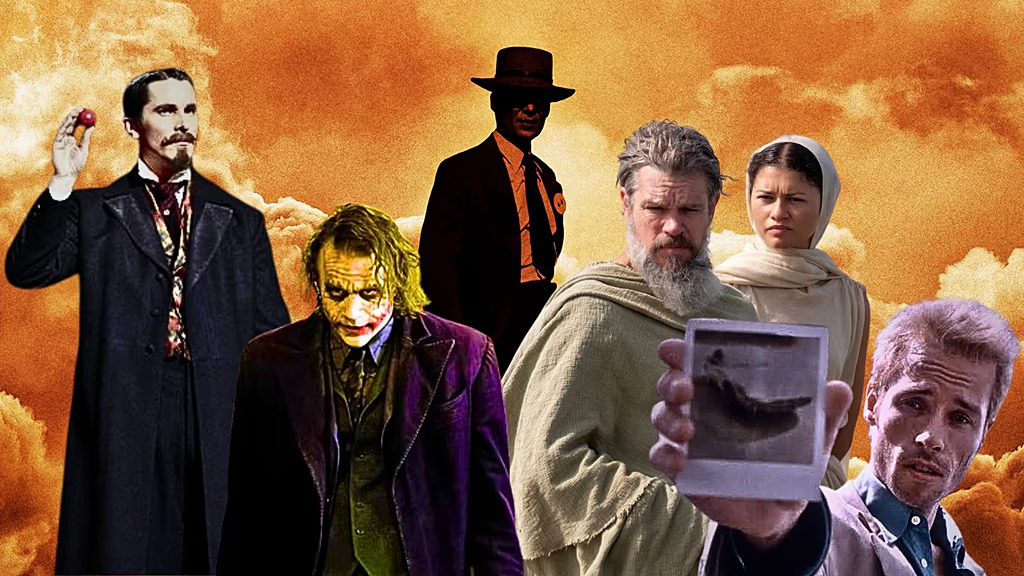
Christopher Nolan has built one of modern cinema’s most distinctive bodies of work. His films repeatedly explore fractured timelines, obsession, guilt, identity and the personal cost of ambition.
Following the release of The Odyssey, Euronews Culture ranked all 13 of Nolan’s feature films from weakest to strongest.
Nolan’s work has generated both intense admiration and recurring criticism. Supporters celebrate his practical spectacle, intricate plotting and technical precision. Critics, however, often point to emotionally distant characters, unnatural dialogue, overwhelming sound design and female roles that receive less development than their male counterparts.
Here is the complete ranking, beginning with the filmmaker’s least successful feature and ending with what Euronews Culture considers his finest work.
13. Following — 1998
Nolan’s feature-length debut is a 70-minute, black-and-white neo-noir made on a reported budget of approximately $6,000. Jeremy Theobald plays an aspiring writer who begins secretly following strangers through the streets of London. His habit appears harmless at first, but it soon draws him into a dangerous relationship and a world of manipulation, theft and shifting identities. Despite its limited resources, Following introduces several themes that would later define Nolan’s career. These include obsession, unstable identity, deception and nonlinear storytelling. The film is an impressive example of low-budget filmmaking, although its pacing and character development can feel underdeveloped compared with Nolan’s later productions.
12. Tenet — 2020
Few films in Nolan’s career are as conceptually ambitious as Tenet. John David Washington stars as an unnamed intelligence operative who becomes involved in a global conflict centred on technology capable of reversing the movement of people and objects through time. The film contains several technically remarkable action sequences, including fights that unfold both forwards and backwards. Its visual construction and large-scale set pieces demonstrate Nolan’s continuing commitment to practical filmmaking. However, the complicated rules of the story are explained through heavy exposition, while the characters often feel emotionally distant. The overwhelming sound design also makes portions of the dialogue difficult to understand. Elizabeth Debicki gives the film some emotional weight, but her character is largely defined by her relationship with an abusive husband. As a result, Tenet can feel more like an elaborate intellectual mechanism than a fully satisfying drama.
11. Insomnia — 2002
A remake of Erik Skjoldbjærg’s 1997 Norwegian thriller, Insomnia follows an experienced detective investigating a murder in an Alaskan town where the summer sun never sets. Al Pacino plays Will Dormer, a detective whose judgment becomes increasingly unreliable as sleep deprivation, guilt and professional pressure begin to affect him. Hilary Swank appears as a local investigator, while Robin Williams delivers an unsettling performance that contrasts sharply with the comedic roles for which he was best known. Unlike many of Nolan’s later films, Insomnia does not rely on complex timelines, enormous action sequences or elaborate science-fiction concepts. Instead, it operates as a tense and morally bleak psychological thriller. Although it is one of the director’s less distinctive works, it remains an effective and frequently overlooked part of his filmography.
10. The Dark Knight Rises — 2012
The final instalment of Nolan’s Batman trilogy expands the conflict into a battle for the future of Gotham City. Christian Bale returns as Bruce Wayne, who has withdrawn from public life following the events of The Dark Knight. He is eventually forced to become Batman again when the masked revolutionary Bane threatens the city. Tom Hardy brings considerable physical menace to the role of Bane, while Anne Hathaway delivers an energetic and charismatic performance as Selina Kyle. The film draws partly from Charles Dickens’ A Tale of Two Cities, particularly in its depiction of revolution, social division and sacrifice. However, the story is less controlled than those of the previous two Batman films. Plot inconsistencies, uneven pacing and an overextended screenplay prevent it from reaching the level of Batman Begins or The Dark Knight. It remains an ambitious conclusion, but not an entirely successful one.
9. Dunkirk — 2017
Dunkirk recreates the evacuation of Allied soldiers from France during the Second World War through three overlapping timelines. The first follows soldiers trapped on the beach over the course of one week. The second follows civilian boats crossing the English Channel during a single day. The third takes place in the air during one hour of combat. These separate timelines gradually converge as soldiers, pilots and civilians struggle to survive. Rather than relying on conventional dialogue or detailed backstories, Nolan uses sound, editing and visual composition to create a continuous sense of pressure. The ticking structure of Hans Zimmer’s score contributes to the feeling that time is constantly running out. The technical execution is extraordinary, and the film places the audience inside the evacuation instead of explaining it through traditional exposition. That approach is also one of its limitations. Many of the characters function primarily as parts of the film’s structure rather than as fully developed individuals.
8. Interstellar — 2014
Matthew McConaughey plays Cooper, a former pilot who leaves his family to join a mission searching for a new home for humanity. Earth is becoming increasingly unable to sustain human life, forcing Cooper and a team of scientists to travel through a wormhole and investigate potentially habitable planets. The film combines theoretical physics and cosmic spectacle with an emotional story about the relationship between a father and his daughter. Hoyte van Hoytema’s cinematography gives the production enormous visual power. The sequence set on a water-covered planet, where time passes at a radically different rate, remains one of Nolan’s most memorable creations. McConaughey also delivers one of the film’s strongest moments when Cooper watches years of recorded messages from his children after experiencing only a short period of time himself. However, the screenplay frequently explains its themes too directly. The final section, involving a multidimensional structure that allows Cooper to communicate through time, has also divided audiences. Its ambition is undeniable, even when its emotional and scientific ideas do not fully come together.
7. The Odyssey — 2026
Nolan’s adaptation of Homer’s ancient Greek epic represents one of the largest productions of his career. Filmed entirely using IMAX technology, the movie follows Odysseus on his difficult journey home after the Trojan War. Rather than presenting the source material as a straightforward fantasy, Nolan reduces some of its supernatural elements and adopts a more psychological and modern interpretation of its central character. The scale of the production is immense, while the technical craftsmanship reflects the director’s continuing interest in practical environments and large-format filmmaking. However, the film’s fragmented chronology and abrupt transitions sometimes weaken the story’s momentum. Several of Odysseus’ encounters pass without developing the tension or emotional weight they require. The first half is particularly slow, although the final section is more focused and dramatically effective. The Odyssey inspires admiration for its scale and construction, but it does not always establish a strong emotional connection with its characters.
6. Oppenheimer — 2023
Adapted from Kai Bird and Martin J. Sherwin’s biography American Prometheus, Oppenheimer examines the life of physicist J. Robert Oppenheimer. Cillian Murphy plays the scientist who led the Manhattan Project, the secret American programme responsible for developing the atomic bomb during the Second World War. The film also explores the political campaign that later damaged Oppenheimer’s reputation and resulted in the removal of his security clearance. Murphy anchors a large ensemble with a restrained and intense performance. Robert Downey Jr., Emily Blunt, Matt Damon and Florence Pugh appear in supporting roles. The film’s fragmented chronology moves between Oppenheimer’s scientific career, the development of the bomb and later political hearings. Unlike some of Nolan’s more confusing narrative experiments, the structure here strengthens the themes of memory, guilt, ambition and historical responsibility. Ludwig Göransson’s score adds considerable tension, particularly during the Trinity test sequence. However, the female characters played by Blunt and Pugh receive considerably less development than the central male figures.
5. Batman Begins — 2005
After the critical failure of Batman & Robin, Nolan rebuilt the Batman franchise by focusing on Bruce Wayne’s psychology. The film follows Wayne’s childhood trauma, his training and his eventual decision to create Batman as a symbol capable of frightening Gotham’s criminals. Christian Bale’s performance makes the conflict between Bruce Wayne and his masked identity central to the story. The grounded treatment differs significantly from both Tim Burton’s gothic Batman films and Joel Schumacher’s colourful, exaggerated approach. Nolan presents Gotham as a city shaped by corruption, organised crime, economic inequality and institutional failure. The supporting cast includes Michael Caine as Alfred, Gary Oldman as Jim Gordon, Liam Neeson as Ra’s al Ghul and Cillian Murphy as Jonathan Crane. By treating the superhero origin story with the structure and seriousness of a crime drama, Batman Begins helped redefine the genre and laid the foundation for the trilogy’s strongest instalment.
4. Inception — 2010
Leonardo DiCaprio stars as Dom Cobb, a specialist who enters other people’s dreams to steal valuable information from their subconscious minds. Cobb is offered an opportunity to return to his children if he completes a more difficult task: planting an idea inside someone’s mind. The mission requires Cobb and his team to create several dream levels, each operating at a different speed and with its own physical conditions. The cast also includes Joseph Gordon-Levitt, Elliot Page, Tom Hardy, Ken Watanabe, Marion Cotillard and Cillian Murphy. Despite its complicated rules, Inception maintains the momentum of a large-scale heist and espionage film. Its most memorable sequences include a fight in a rotating corridor, a collapsing cityscape and the simultaneous climax unfolding across multiple dream layers. Hans Zimmer’s score adds further intensity, while the unresolved final shot has remained a subject of debate. The film demonstrated that a major studio blockbuster could challenge audiences intellectually while still delivering action, spectacle and suspense.
3. Memento — 2000
Guy Pearce plays Leonard Shelby, a man who is unable to form new long-term memories after suffering a serious injury. Leonard is searching for the person he believes murdered his wife. Because he cannot remember recent events, he relies on photographs, handwritten notes and tattoos to guide his investigation. Nolan presents the story through two narrative strands. The colour sequences move backwards, while the black-and-white scenes progress chronologically. The two timelines eventually meet, revealing how Leonard’s condition makes him vulnerable to manipulation by others and by himself. The structure is not merely a storytelling trick. It places the audience inside Leonard’s unstable perception, forcing viewers to experience uncertainty similar to his own. The film explores grief, guilt, memory, self-deception and the human tendency to construct comforting explanations. Memento demonstrated that Nolan’s nonlinear methods are most effective when the formal complexity remains closely connected to character psychology.
2. The Dark Knight — 2008
Nolan’s second Batman film expands the moral and criminal conflicts introduced in Batman Begins. Christian Bale returns as Bruce Wayne, while Aaron Eckhart plays district attorney Harvey Dent, a public figure who appears capable of fighting Gotham’s corruption without wearing a mask. The defining addition is Heath Ledger’s Joker, a criminal who seeks to prove that social order and morality can collapse under sufficient pressure. Ledger’s casting initially faced scepticism, but his performance became one of the most celebrated in the superhero genre. He received a posthumous Academy Award for the role. Rather than functioning as a conventional comic-book villain, the Joker acts as an unpredictable force who repeatedly places the film’s characters in impossible moral situations. The movie combines superhero spectacle with the atmosphere and structure of a crime thriller. Its major themes include order, chaos, surveillance, sacrifice and the compromises political institutions make in response to fear. The performances, practical action and moral uncertainty helped make The Dark Knight one of the most influential comic-book adaptations ever produced.
1. The Prestige — 2006
Adapted from Christopher Priest’s novel, The Prestige follows two rival magicians in late-19th-century London. Hugh Jackman plays Robert Angier, while Christian Bale portrays Alfred Borden. What begins as professional competition gradually develops into a destructive obsession. Each man becomes determined to discover the other’s secrets and create the greatest stage illusion, regardless of the personal cost. The narrative is organised around the three stages of a magic trick: the pledge, the turn and the prestige. This structure allows Nolan to explore deception not only within the story but also through the filmmaking itself. Information is concealed, perspectives are manipulated and earlier scenes acquire new meaning once the full truth is revealed. The supporting cast includes Michael Caine, Scarlett Johansson, Rebecca Hall and David Bowie as inventor Nikola Tesla. Unlike some of Nolan’s more complicated films, the nonlinear structure directly serves the characters and subject. The rivalry between Angier and Borden becomes an examination of sacrifice, ego, identity and the destructive consequences of artistic ambition. Its repeated shifts in perspective make the film especially rewarding on subsequent viewings. For Euronews Culture, the combination of narrative control, psychological depth and thematic precision makes The Prestige Christopher Nolan’s strongest film.