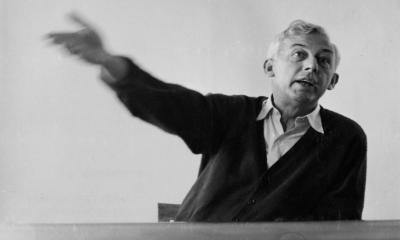

Published: : September 3, 2026, 01:14 PM

“There is none like Uttam and there will be no one to ever replace him.”
— Satyajit Ray
Every September 3, Bengali cinema remembers a birthday that feels more than a celebration. It is the birthday of a man who died decades ago but still appears in old cinema halls, television screens, photographs, posters, social media profiles and, most importantly, in the hearts of Bengali audiences. Uttam Kumar was born on September 3, 1926, and 2026 marks the centenary of his birth. Yet his importance has never remained limited to a date on a calendar. He continues to represent an emotion, an era and a unique idea of what a hero could be.
The first Uttam Kumar film I watched was Nayak. I was in class seven then. A teacher had told me about Uttam Kumar and his legacy. Then I saw him on screen. For the first time, I saw a face that could be a perfect definition of a hero. I noticed the fashion, the way of speaking and the gestures he made. He seemed like something beyond an actor inside the frame. Years later, I still remain connected with Uttam Kumar. But now I do not see him the way I first saw him in Nayak. Now I see the actor who spent more than three decades becoming and repeatedly challenging the idea of the Bengali hero. Perhaps that is the real Uttam Kumar story. It is not only about how a star was born. It is about how an actor survived his own stardom.
Uttam Kumar was born as Arun Kumar Chattopadhyay in Calcutta, then part of the Bengal Presidency of British India. His beginning in cinema was far away from the legend he would later become. His first screen appearance was in the unreleased Hindi film Maya Dore. His first released film was Drishtidan (1948), directed by Nitin Bose, where he appeared in a supporting role. His early career was filled with struggles and commercial failures before he finally found his place in the industry.
The turning point came with Basu Paribar (1952), which became his first major commercial success and established him as a rising star. Then came Sharey Chuattor (1953), the film that introduced the historic pairing of Uttam Kumar and Suchitra Sen. Their partnership became one of the most influential romantic collaborations in Bengali popular cinema. However, the magic of Uttam and Suchitra was not simply that they looked perfect together. They created a unique language of romance. Uttam understood the natural rhythm of love, hesitation and emotion. His romance was often expressed through silence, expressions and small gestures rather than only through dramatic words.
Gradually, Uttam Kumar became something much larger than a hero. He became the image of the Bengali “bhadralok”. He became the “Mahanayak”. His fashion, gestures, speech and manners created a powerful image for the Bengali male audience. He could be the gentleman in a Punjabi, the educated middle-class man, the sophisticated lover, the respectable husband and also the wounded person hiding behind a confident exterior.
His stardom became deeply connected with the cultural imagination of post-Partition Bengal. He represented the dreams and struggles of a generation searching for identity and stability. Beneath the polished image was something familiar. He could embody the aspirations of ordinary people while also revealing the anxieties hidden behind those aspirations. This balance between fantasy and reality made Uttam Kumar different from many other stars.
This is where his stardom becomes fascinating. A star survives through recognition. Audiences enter theatres because they already know something about the person they are going to watch. Uttam Kumar understood those expectations. But instead of becoming trapped by them, he started challenging them.
In Harano Sur (1957), he played a man struggling with lost memory. In Saptapadi (1961), he carried themes of love, religion, identity and social division. In Chiriyakhana (1967), he entered the world of detective fiction by portraying Byomkesh Bakshi. In Antony Firingee (1967), he moved far away from the familiar Bengali gentleman image and portrayed a Portuguese-origin performer connected with Bengali folk culture. These roles showed that Uttam Kumar was not only a romantic hero. He was an actor constantly searching for new possibilities.
Films such as Grihadaha, Jatugriha, Lal Pathar, Stree and Amanush revealed increasingly complex versions of the man audiences thought they already knew. These characters carried pain, conflict, loneliness and moral struggles. Through these performances, Uttam Kumar expanded what a Bengali film star was allowed to be.
In 1967, when the National Film Awards introduced the Best Actor category, Uttam Kumar became the first recipient of the award for his performances in Antony Firingee and Chiriyakhana. This honour was important because it recognised not only his popularity but also his artistic ability. His contribution to Bengali cinema also extended beyond acting. He worked as a producer and contributed to several important films that received national recognition.
However, awards only tell a small part of Uttam Kumar’s story. His greatest achievement was his ability to make audiences believe in him. He understood the power of subtle emotional expression and controlled performance. He did not need exaggerated gestures to create impact. A look, a pause or a simple movement could reveal the inner world of a character.
Uttam Kumar never seemed completely separated from the people who watched him. Behind the impossible fame and carefully created image was something ordinary and human. He could represent the dream of the Bengali middle-class man while also showing the difficulties behind that dream. This is why his image survived changes in fashion, technology and generations. We first saw the star and then discovered the actor.
His connection with cinema continued until the final days of his life. While shooting Ogo Bodhu Sundori, he became seriously ill and was admitted to Belle Vue Clinic. He died on July 24, 1980, at the age of 53. His death created a sense of loss that went beyond the film industry because audiences felt they had lost someone who had become a part of their own cultural memory.
The Mahanayak effect remains. After all these years, we no longer see only the hero. We see the man behind the hero. Perhaps that is Uttam Kumar’s greatest victory. He achieved this through extraordinary dedication, hard work and an endless desire to explore beyond his own image. He became so convincing as a hero that every generation first fell in love with the star and then slowly learned to appreciate the actor beneath it. Behind the hero, there was always an artist searching for something beyond fame. And that is why every September 3, Bengali cinema does not only celebrate Uttam Kumar’s birthday. It remembers the man who became something beyond the title “Hero”.
Fardwin Khan is a student of Department of Film and Television at Jagannath University.
Send your reviews, articles, and pitches for Cut to Cinema to [email protected]. Check out our submission guidelines for more details.