
Published: : August 3, 2026, 01:24 PM
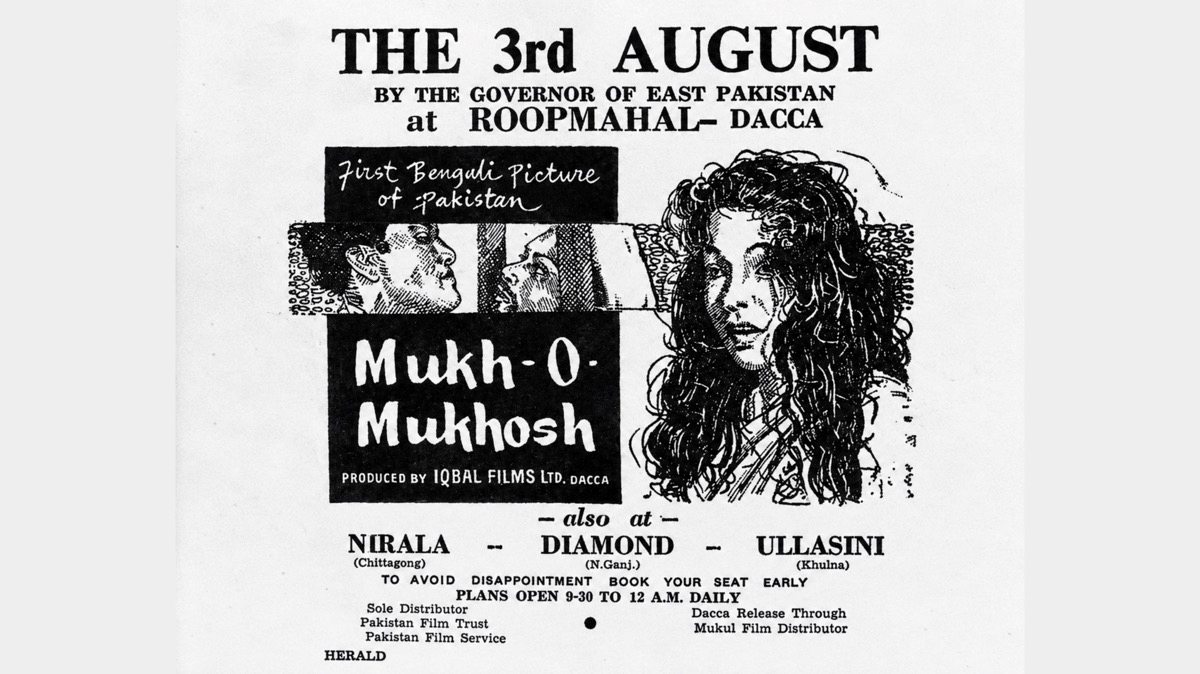
Bangladesh marks 70 years today since the release of Mukh O Mukhosh, the film widely regarded as the starting point of the country’s organised feature-film industry. Directed by Abdul Jabbar Khan, it premiered at Roopmahal Cinema Hall in Dhaka on 3 August 1956. The opening show was inaugurated by Sher-e-Bangla A. K. Fazlul Huq, who was then Governor of East Pakistan.
Produced under the banner of Iqbal Films, Mukh O Mukhosh was the first full-length Bengali-language sound feature made in East Pakistan, the territory that later became Bangladesh. Its importance lies not only in being a pioneering production, but also in proving that a Bengali film could be created locally at a time when the region had almost no established filmmaking infrastructure.
After the partition of British India in 1947, cinemas in East Pakistan largely depended on films produced elsewhere. Bengali films came mainly from Kolkata, while Hindi, Urdu and Hollywood productions also dominated local screens. Dhaka had actors, theatre workers and cultural activists, but it did not yet have a functioning feature-film industry supported by studios, laboratories and experienced technical crews.
Abdul Jabbar Khan, who was primarily known for his work in theatre, decided to challenge that limitation. He adapted his stage play Dakat into a film and brought together performers and technicians with little or no previous cinema experience. Production began in December 1953, and filming took place at several locations in and around Dhaka. The project continued for more than two years.
The filmmakers faced serious technical and social obstacles. East Pakistan did not have the facilities required to process the film, so the negatives were sent to Lahore for development, editing and printing. Finding female performers was also difficult because acting in films was widely discouraged for women at the time. Purnima Sengupta, Zahrat Ara and Piyari Begum were among those who joined the cast. Abdul Jabbar Khan also played a leading role, while Inam Ahmed appeared as the bandit chief. Contemporary and retrospective accounts state that many performers participated voluntarily and without payment.
Samar Das composed the film’s music, while Abdul Alim and Mahbuba Rahman contributed as playback singers. The film was also screened in Chattogram, Narayanganj and Khulna, helping it reach audiences beyond the capital.
The public response established that there was strong demand for Bengali-language films produced within the region. More importantly, Mukh O Mukhosh gave local artists, producers and technicians the confidence to pursue further film projects. It helped create the momentum that eventually led to the growth of a professional film industry centred in Dhaka.
Seven decades later, Mukh O Mukhosh remains more than a historical title. It represents creative courage, cultural self-expression and the determination to build an industry despite limited resources. Its release on 3 August 1956 opened a new chapter in Bengali cinema and laid an essential foundation for the film culture of Bangladesh, and continues to command a permanent place in its cultural history.