
Published: : July 7, 2026, 10:38 AM
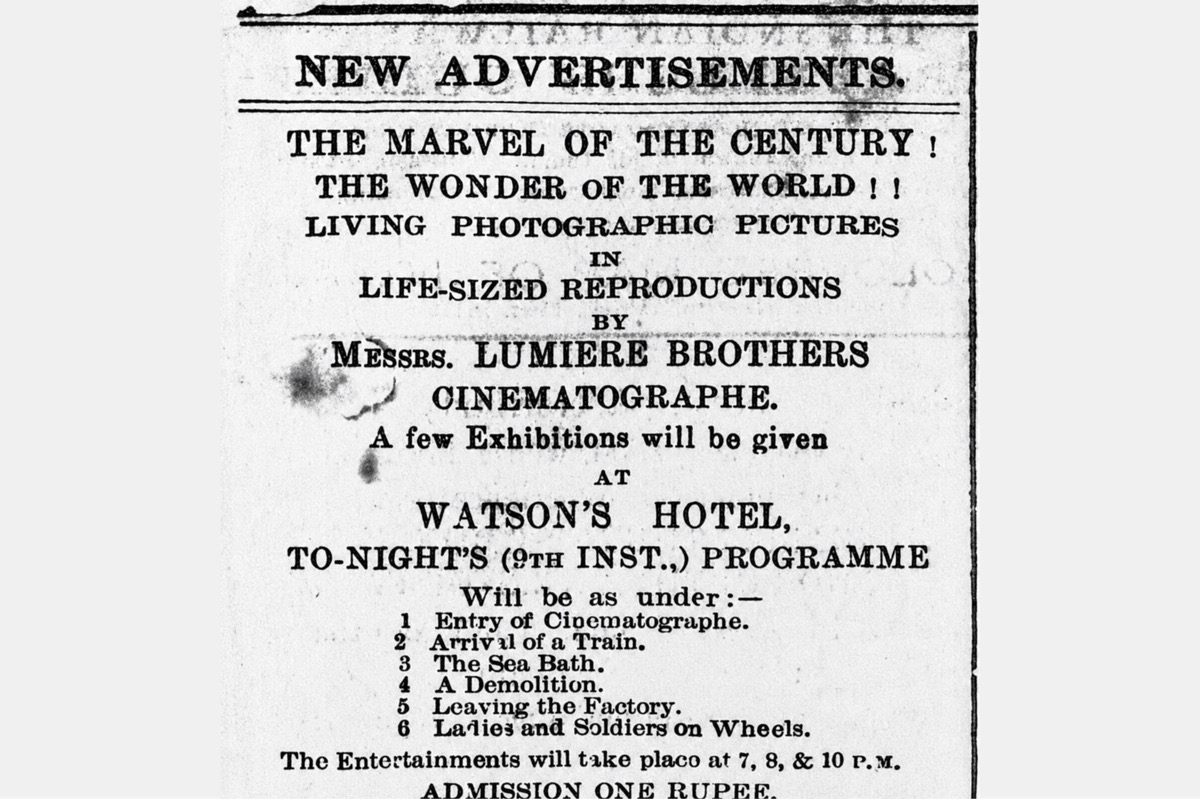
The night cinema arrived in the Indian subcontinent was 7 July 1896. On that evening, the first recorded public film projection in India took place at Watson’s Hotel in Bombay, now Mumbai. The exhibition was arranged by Marius Sestier, a representative of the Lumière company. He used the Lumière Cinématographe to show moving pictures before an audience in colonial Bombay. The National Film Archive of India records that Sestier held the first screening of films in India at Watson’s Hotel on this date.
The history of this event began in France. On 28 December 1895, the Lumière brothers held their first public screening of the Cinématographe in Paris, at the Salon Indien du Grand Café. This programme contained ten short films. The event became one of the most important moments in the early history of cinema because it showed that moving photographic images could be projected before a paying public. Within a few months, the Lumière company began to send its trained operators to different parts of the world.
Marius Sestier was one of those operators. He was not one of the Lumière brothers. He was a French chemist and camera operator connected with the Lumière firm. The company sent him to India with the Cinématographe in June 1896. His first film show in India was held at Watson’s Hotel on 7 July 1896. After his exhibitions in India, he later travelled to Australia.
The place of the first show was also important. Watson’s Hotel was situated in the Kala Ghoda area of Bombay. It was one of the well-known colonial hotels of the city. For this reason, cinema did not first appear in India as a popular entertainment for the general public. It first appeared as a modern technological attraction in an elite urban space. The exact number of people who attended the first show is not clearly recorded. It is also not clearly known how many Indians were present in the audience. Therefore, it is safer to say that the first audience belonged mainly to the urban colonial public of Bombay.
Advertisements for the show appeared in Bombay newspapers on the morning of the screening. The Cinématographe was presented as a new wonder of the world. The audience was invited to see “living photographic pictures” projected in motion. At that time, people knew photography, theatre, magic-lantern shows, and other forms of visual entertainment. But the projection of moving photographs on a screen was a new experience. It created a new relation between the viewer and the image.
The show was arranged in the evening. Contemporary accounts mention four shows on 7 July 1896, at 6 p.m., 7 p.m., 9 p.m., and 10 p.m. The admission price was one rupee. This was a high price for the period, and it shows that the first film projection was not yet a cheap mass entertainment. It was first presented as a special scientific and visual attraction for people who could afford the ticket.
The films shown at Watson’s Hotel were not Indian films. They were short Lumière films brought from Europe. According to the National Film Archive of India, the five films screened at Watson’s Hotel on 7 July 1896 were Entry of Cinematograph, Arrival of a Train, The Sea Bath, A Demolition, and Workers Leaving the Factory Gate. These were actuality films. They recorded simple real-life scenes instead of fictional stories.
The subjects of the films were ordinary. A train arrived. Workers came out of a factory. People bathed in the sea. A wall was demolished. But the importance of these films was not in story or acting. Their importance was in motion. For the audience of 1896, the moving image itself was the attraction. A still photograph could show a moment, but the Cinématographe could show life continuing before the eyes of the viewer.
This first screening should not be confused with the first Lumière programme in Paris. Some films often connected with the early Lumière shows, such as The Sprinkler Sprinkled or Baby’s Dinner, belonged to the wider Lumière catalogue and to the Paris programme. For the Bombay screening of 7 July 1896, the safer list is the five-film list recorded by the National Film Archive of India.
It is also important to avoid another common mistake. The Lumière brothers themselves did not come to India to arrange this show. The exhibition was conducted by Marius Sestier, their agent and operator. It is also not correct to say that this event was the beginning of Indian filmmaking. The films were made in Europe. The event was the beginning of public film projection in India, not the beginning of Indian film production.
After the first evening, the shows continued in Bombay. Screenings followed on 9 July, and further shows were arranged on 10 and 11 July. Later, Sestier shifted the exhibitions to the Novelty Theatre in Bombay. A planned show on 14 July was cancelled because of a power failure, but screenings resumed on 21 July. These later exhibitions show that the first screening was not an isolated event. It opened the way for more regular film exhibition in Bombay.
The arrival of cinema in the Indian subcontinent was therefore gradual but clear. It began with imported short films, a foreign machine, and a European operator. At first, cinema was seen as a scientific wonder and a modern visual attraction. It had not yet become a local art form or an industry. But the exhibition at Watson’s Hotel created the first public contact between the people of the subcontinent and projected moving images.
The historical value of 7 July 1896 lies in this beginning. On that night, cinema entered the public life of the Indian subcontinent. The show was small, the films were short, and the audience was limited. Yet the event introduced a medium that would later become one of the most powerful cultural forms in South Asia. From such short actuality films, the subcontinent would later move towards local filming, silent cinema, talkies, studio systems, regional film industries, and mass popular cinema.
Thus, The Night Cinema Arrived in the Indian Subcontinent was not the night of a long feature film, a famous actor, or an Indian director. It was the night of a machine, a screen, a few short films, and an audience seeing motion in a new way. The date was 7 July 1896. The place was Watson’s Hotel, Bombay. The exhibitor was Marius Sestier. The machine was the Lumière Cinématographe. The films were short Lumière actuality films. From that evening, the story of cinema in the Indian subcontinent began.