
Published: : June 21, 2026, 05:12 PM
There is a scene in Abbas Kiarostami's 1994 masterpiece (critically acclaimed), Through the Olive Trees, that has been flattened by the modern internet. Much like countless other images from classic cinema, it now frequently appears on social media as aesthetic decoration. People attach melancholic songs to it. They use it as a backdrop for captions about longing and heartbreak. They repost it because it looks beautiful. And yet I cannot help but wonder how many people are actually watching the scene rather than merely consuming it.
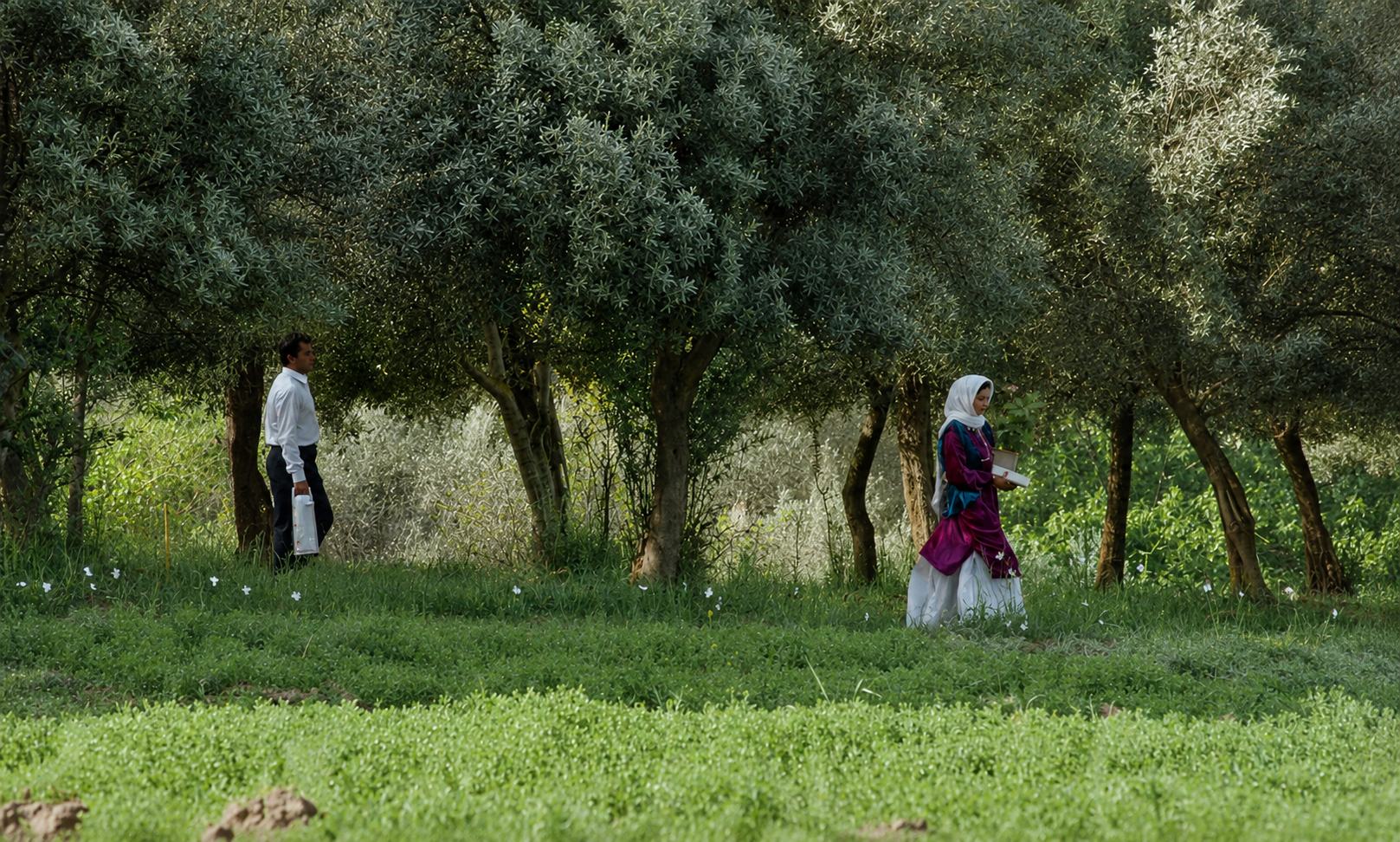
The scene itself is deceptively simple. A winding path cuts through a lush green landscape. The wind moves through the grass. Two figures walk across the frame. Tahereh, dressed in a vibrant purple tunic over a flowing white skirt (a local schoolgirl cast as the bride in the film being shot), carries a flowerpot containing a single red blossom. Hossein follows behind her, holding a floral tea flask and a blue bucket. As they climb the steep path, Hossein continues his pursuit of a response that has long been denied to him. He pleads through the wind:
“Just give me your answer! If you won’t answer, at least let me carry the flowerpot. If I'd known it was yours, I'd have watered it myself.”
It is a remarkably ordinary line, and perhaps that is precisely why it hurts. He is not asking for a grand romantic gesture. He is asking for acknowledgment.
For those of us living in South Asia, or indeed in any society where class, family expectations, and social standing continue to influence the terms of love, Through the Olive Trees rarely feels like a distant Iranian film from the 1990s. One watches Hossein and immediately thinks of familiar stories. Stories of proposals rejected not because affection was absent but because status was. Stories of people being told that they are not educated enough, wealthy enough, or respectable enough. We often tell ourselves that love transcends such considerations, but reality frequently suggests otherwise. Kiarostami understood this reality with remarkable clarity.
To understand why the film continues to resonate, one must also understand its fascinating structure. Through the Olive Trees is the final installment of Kiarostami's Koker Trilogy. The film follows a crew shooting a movie in a village devastated by the 1990 earthquake (specifically the 1990 Manjil–Rudbar earthquake in northern Iran). This film within the film is actually the previous entry in the trilogy, And Life Goes On. At the center of the story are Hossein, a local bricklayer cast as a groom, and Tahereh, a student cast as his bride. In the movie being filmed, they are happily married. Outside the frame, however, Hossein's marriage proposal has already been rejected by Tahereh's family because he is poor and illiterate (more broadly due to poverty, limited education, and lower social standing). The film exists within the tension between "Action" and "Cut." Every time filming begins, Tahereh must perform affection. Every time filming ends, she returns to silence.
I often find myself thinking about that silence. Much has been written about Hossein's persistence, but Tahereh's silence remains equally fascinating. She rarely explains herself. She offers no dramatic speeches and no emotional confessions. Instead, she becomes a presence that resists interpretation. In contemporary storytelling, we are often given exhaustive explanations for every character's motivations. Kiarostami offers remarkably little. Why does she remain silent? Is it rejection? Is it caution? Is it obedience to family expectations? Or is it something else entirely? The film never answers these questions directly, and perhaps that ambiguity is one of its greatest strengths.
Why are we so attracted to the visuals of this film? The obvious answer is that Kiarostami was a master image-maker. Critics often describe his work as Slow Cinema (a term used by some critics for long-take, minimalist observational filmmaking, though it is not universally applied to all his work). But I sometimes wonder whether our attraction to these images has less to do with cinema and more to do with exhaustion. We spend much of our lives moving between screens, notifications, advertisements, and algorithms competing for our attention. In such an environment, Kiarostami's images feel almost radical. They refuse urgency. They refuse spectacle. They ask nothing from us except patience.
The landscapes themselves play an essential role in creating this feeling. Kiarostami's use of deep focus allows the olive trees, distant mountains, crumbling stone walls, and open skies to coexist alongside the human drama. Nothing is isolated from its surroundings. This feels profoundly truthful. When we experience heartbreak, disappointment, or grief, the world does not pause in recognition. Birds continue singing. Trees continue swaying. People continue living their lives. The beauty of the landscape does not erase Hossein's pain. Rather, it places it within a larger world that remains indifferent yet enduring. There is something strangely comforting about that perspective.
The emotional core of the film lies in Hossein's argument for his own worth. In one of the film's most heartbreaking conversations, he explains why he believes he deserves Tahereh. His logic is simple. If the educated only marry the educated and the wealthy only marry the wealthy, then how can anyone ever improve their circumstances? Beneath the romantic narrative lies a powerful critique of social hierarchy. Listening to him, one begins to think about the countless ways society continues to categorize people according to status. We claim to value equality, yet we constantly sort human beings through the lenses of education, income, profession, and family background. Hossein represents every person who has been told that they are somehow insufficient.
Perhaps this is why the final scene continues to circulate so widely online. It is not merely beautiful. It contains one of the most universal emotional experiences imaginable: the desire for an answer. As Hossein follows Tahereh through the olive grove, we find ourselves hoping alongside him. We want her to turn around. We want her to acknowledge him. We want certainty. Yet Kiarostami denies us that certainty. The figures become smaller and smaller until they are little more than distant specks. Did she answer him? Did she reject him? Did something change between them? The camera remains too far away for us to know. Every viewer is left to project their own hopes onto that distance.
Kiarostami's brilliance lies in his willingness to leave us there. In a culture increasingly obsessed with resolution, explanation, and definitive answers, Through the Olive Trees embraces uncertainty. It acknowledges that life rarely provides the clarity we seek. Sometimes we never receive the answer. Sometimes all we are left with is the walk itself. Hossein may or may not succeed in winning Tahereh's affection. The film never tells us. What it does tell us is far more important. It reminds us that human dignity resides not only in achievement but also in persistence.