
Published: : July 11, 2026, 12:08 AM
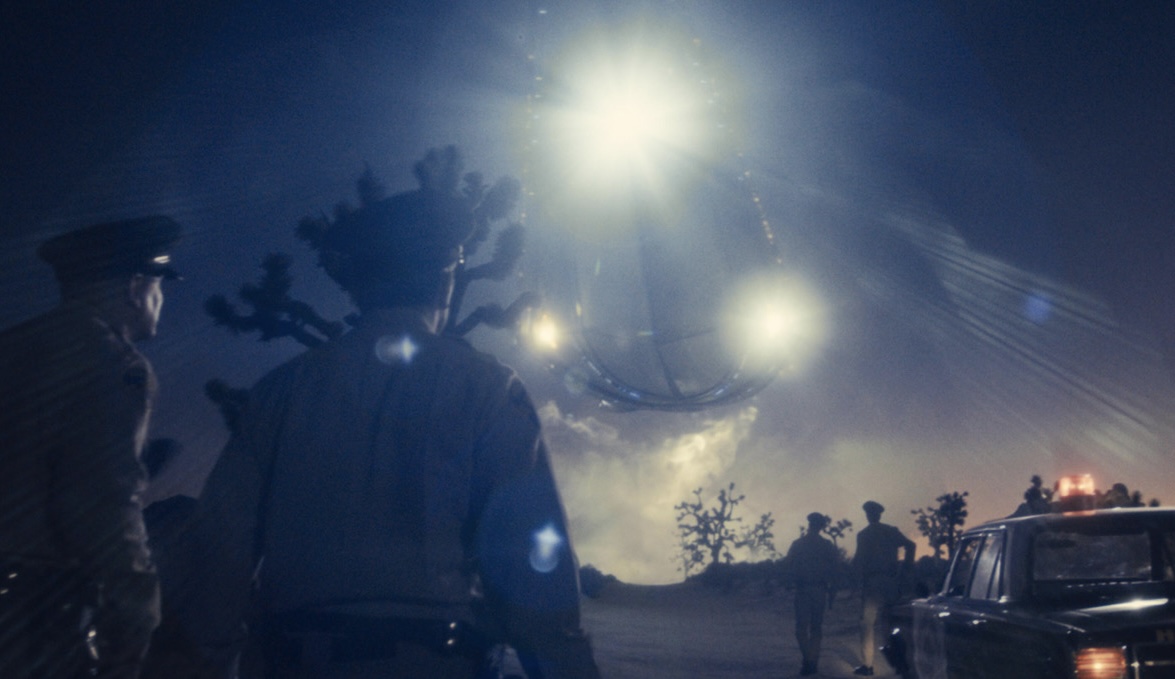
With ‘Disclosure Day’, Steven Spielberg transforms America’s great UFO myths into a deeply humanistic late-career work about hope, communication and the possibility of reimagining the world.
There were good reasons to believe that Steven Spielberg had bid farewell with The Fabelmans in 2022. Not to cinema, but perhaps to the quest that has shaped his work over five decades. Hardly any other film seemed so conciliatory, so complete. Spielberg looked back on his childhood, his family, his wounds and his passions. It was a film full of wisdom, full of melancholy and also gratitude. A work that felt like a full stop.
Yet apparently it was not.
For with ‘Disclosure Day’, Spielberg, at almost 80 years of age, is not merely returning to science fiction. He is returning to that form of the modern fairy tale that once made him the director who decisively shaped popular cinema of the late 20th century. And perhaps it had to happen right now. At a time when wars have not only become conceivable again but are a reality, when political systems are eroding, conspiracy theories are flourishing and the future increasingly appears as a threat, Spielberg responds not with cynicism, but with hope.
That may sound naive and like the usual Spielberg blockbuster claptrap. But it’s not that simple.
For Disclosure Day is no escapist spectacle. It is a film about the question of why humanity can no longer listen to itself. That is also why the most important word in this film is, accordingly: “Listen!”
Listen.
It is an astonishing decision. Whilst many contemporary science fiction films seek their answers in technology, artificial intelligence or apocalyptic scenarios, Spielberg is interested in something else. He is preoccupied with the communication crisis of the present day. The inability to listen. The speechlessness between nations, generations and political camps.
Perhaps that is why the news footage at the end of the film is among its most moving moments. Time and again, Spielberg shows people sitting in front of screens. Politicians. Soldiers. Families. Journalists. They are watching the same images. And they can no longer find the words for them. This speechlessness is more harrowing than any catastrophe.
For ‘Disclosure Day’ ultimately tells the story of a humanity that has reached its own limits.
In doing so, Spielberg delves deep into the treasure trove of those myths that have accompanied him for decades. From Roswell to E.T. the Extra-Terrestrial, from UFO sightings to the countless conspiracy narratives of post-war American history. The famous Roswell incident of 1947 serves as an important resonant space, the anchor of this narrative, so to speak. At that time, debris was discovered in New Mexico that was initially described as a ‘flying saucer’ and shortly afterwards explained away as a weather balloon. This contradiction gave rise to one of the most enduring conspiracy narratives of the 20th century: the idea that governments are keeping the existence of extraterrestrial life a secret.
Spielberg, however, is not interested in the question of whether these stories are true. Rather, he asks why people tell them.
And his answer is surprisingly simple: because they hope. Because behind all UFO myths lies, ultimately, the same longing. The longing not to be alone.
Disclosure Day transforms this longing into a modern fairy tale. Here, the aliens do not appear as invaders, nor as a threat, nor as technologically superior rulers. They appear as a possibility. As the possibility of a different perspective on humanity.
A nun expresses this in one of the film’s most interesting lines. If humans are the finest species on Earth created by God, then there must also be the finest species from other worlds somewhere in the universe. A thought as simple as it is deeply spiritual.
We are not alone.
Interestingly, Spielberg is not alone in this longing at the moment. Only recently, Vince Gilligan’s television series Pluribus also explored the hope of an encounter with another, possibly more advanced species. Yet whilst Gilligan interprets this longing as a symptom of human self-imposed pressure and critically questions whether the expectation of a saviour from elsewhere might not also be a form of overreach or irresponsibility, Spielberg takes a different path. For him, the Visitors are not a projection of human weakness, but a real alternative to the current state of the world. Where Pluribus asks why we seek salvation from outside at all, Disclosure Day answers: because an outside perspective might allow us to recognise once more who we ourselves could be. It is precisely this that makes Spielberg’s film a remarkable counterpoint to the current culture of mistrust. He seeks not to expose, but to understand.
And that also means: we are not limited to ourselves; we do not bear all the responsibility of this world.
It is precisely here that the true greatness of this film lies. Spielberg is not telling an alien story. He is telling a story of humanity. The aliens act as a mirror. They show us what we have lost.
One is repeatedly reminded of the great late works of other American directors. Robert Zemeckis, too, sought the meaning of human existence in his latest film, Here. And Francis Ford Coppola’s final work, Megalopolis, also revolved around the question of how the future can even be imagined anymore. Yet nowhere does this sense of helplessness appear so openly and, at the same time, so vulnerably as in Spielberg’s work.
‘Disclosure Day’ feels like an attempt by a director, now almost eighty years old, to find an answer once more to the most pressing question of his time: Why can’t we manage to live together?
The answer is surprisingly simple: Because we have stopped listening.
Formally, the film is classic, overwhelming cinema that doesn’t always run entirely smoothly, taking a long time, especially at the start, to set the character dynamics in motion and get them flowing. Yet these rough patches are mostly smoothed over by the outstanding ensemble cast, led by the stunning Emily Blunt, who is allowed to ‘shed her skin’ more than once.
After the first third, things start to run increasingly smoothly and Spielberg now directs with the precision that has characterised his work for decades. The camera movements by Spielberg’s long-standing collaborator Janusz Kamiński glide seemingly weightlessly through crowds. Light refracts in window panes and cloud formations. And the sky once again becomes that magical space which, in Close Encounters of the Third Kind and E.T. the Extra-Terrestrial, already bridged the gap between reality and wonder. And which, of course, also makes clear what Bob Dylan already knew back in 1965: ‘You don’t need a weatherman to know which way the wind blows’.
Yet unlike Dylan’s classic “Subterranean Homesick Blues”, John Williams’ soundtrack seems almost old-fashioned; one repeatedly feels as though one has strayed into film history and left the present behind. Yet even that seems entirely logical the very next moment. For this story is an old one, and at its core has been told many times before. It does not begin with UFO reports or science fiction films. It begins with the oldest questions of humanity: Where do we come from? Are we alone? Is there something greater than ourselves?
That is precisely why ‘Disclosure Day’ is less reminiscent of modern blockbusters than of Hans Christian Andersen’s fairy tales. As in ‘Little Claus and Big Claus’, it is about power, goodness and the contradictions of human behaviour. And just as in ‘The Snow Queen’, a force enters the scene here that rises above the mundane realities of everyday life and suspends them for a moment.
Not as a miracle. But as a possibility.
The finale of ‘Disclosure Day’ is also one of the most moving moments in Spielberg’s work. For decades, Spielberg told stories about beings who wanted to go home. E.T. the Extra-Terrestrial wanted to go home. The visitors from Close Encounters of the Third Kind came from far away. And Indiana Jones and his journeys to exotic or historical lands were always, too, attempts to make home a better, more comfortable place. The focus was always on the distance between the worlds.
Now something different is happening. The creature at the end of this film looks like a rather unadorned prop, indeed like an aged, grandfatherly E.T. the Extra-Terrestrial. And it has not come to disappear.
It has come to stay. Above all, however, it has come with a message.
To us.
To humanity.
To a world that is increasingly entangled in enemy stereotypes, wars and mutual certainties.
The message is incredibly simple.
Listen.
Perhaps this is precisely where the greatest radicalism of this film lies – a film that, without a second glance, could easily be mistaken for almost classic B-movie sci-fi fare. At a time when everyone wants to speak, Spielberg makes a film about listening. At a time when conspiracy theories often become an escape from reality, he transforms them into a narrative of hope. And in an age when, in many places, the future appears only as a threat, he dares to do something that has become rare in contemporary cinema: he believes in humanity.
Not blindly. Not naively. But resolutely.
That is precisely why Disclosure Day is not merely grand, overwhelming cinema. It is the late work of a director who, after half a century of film history, still asks the same question as the little boy from The Fabelmans once did: What if the world could be better?
And for two and a half breathtaking hours, Spielberg manages the feat of making us believe that the answer might actually be waiting in heaven. That is magic. The magic of cinema.