
Published: : July 17, 2026, 07:03 PM
“Think you’re escaping and run into yourself. Longest way round is the shortest way home.” – James Joyce, Ulysses
James Joyce understood that anyone returning to one of the foundational texts of European literature must find a new route through it. His Ulysses, published in 1922 became a modern classic precisely because it did not simply illustrate Homer. Joyce relocated the ancient epic to Dublin, transformed the warrior Odysseus into the Jewish-Irish advertising salesman Leopold Bloom, and replaced the slaughter of Penelope’s suitors with cocoa and quiet conversation in a kitchen.
Christopher Nolan does the opposite. His adaptation of The Odyssey remains dutifully close to the famous stations of the journey, yet discovers neither a new form nor a convincing contemporary perspective. The result is a film of enormous technical ambition that adds surprisingly little to a story retold for almost three millennia.
For mostly Western audiences familiar with the myth, Nolan’s three-hour production soon becomes an exercise in recognition. Here comes the Cyclops; therefore, the Sirens cannot be far away. Circe, Calypso and the descent into the underworld arrive more like compulsory entries on a syllabus than episodes charged with discovery or danger.
Even the dramaturgy operates through blunt verbal cues. When Telemachus declares that he feels his father is alive, the film immediately cuts to Odysseus sitting alone on a beach. Trojans are mentioned, and Troy appears. Odysseus tells Calypso, “I have a wife,” and Penelope materialises in the next image. Nolan’s editing does not create associations; it merely illustrates dialogue.
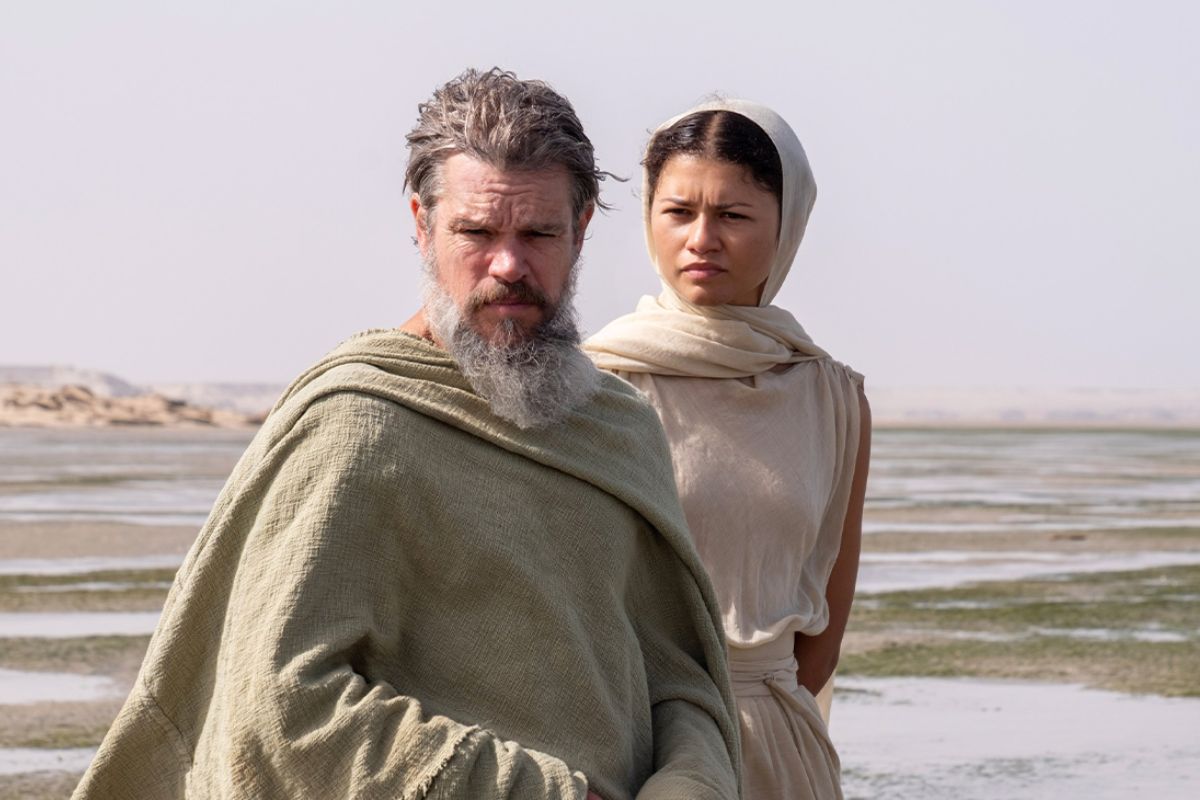
Matt Damon brings the weary physical gravity to Odysseus that he already showed in Ridley Scott’s modern „Odyssey“ The Martian, while Tom Holland gives Telemachus a plausible mixture of insecurity and resentment. Anne Hathaway’s Penelope possesses dignity and restraint, Zendaya’s Athena an appropriately spectral soft washed coolness. Robert Pattinson, Charlize Theron and Lupita Nyong’o also contribute forceful appearances. Yet the actors repeatedly seem like accomplished performers dressed in mythological costumes several sizes too large. The scale is monumental, but the characters remain strangely small inside it.
This has increasingly become Nolan’s central limitation. He is more fascinated by systems than by people: by puzzles, temporal structures, technical processes and the machinery of perception. In his early films, this analytical instinct produced genuine cinematic tension. The reverse chronology of Memento, for example, was inseparable from its protagonist’s damaged consciousness. Form became a mode of knowledge.
In The Odyssey, little remains except the machinery. Nolan answers the episodic nature of the source not by finding a new viewpoint, but by compressing as much material as possible into a single massive construction. The film is so crowded that no episode has enough time to accumulate emotional weight. Places, monsters and secondary characters disappear almost as soon as they arrive. The narrative speaks constantly of loss, temptation and trauma without allowing the audience to experience them.
The encounters with giants, witches and undead warriors sometimes resemble an attempt to turn Greek antiquity into a Marvel franchise. Yet Nolan is not a natural action director. His images are large and expensive, but rarely fluid. The Cyclops looks less archaic than technologically awkward, while the climactic slaughter on Ithaca becomes a heavy and confused sequence of bodies falling beneath pounding music.
The comparison with Uberto Pasolini’s The Return with Ralph Fiennes as Odysseus and Juliette Binoche as Penelope is damaging. That film concentrates only on the final stage of Odysseus’s homecoming and transforms it into a study of ageing, war trauma and estrangement. Its hero has survived the war but no longer fits naturally into the home to which he returns. Nolan needs three hours to reach similar material and still treats it with far less psychological and moral precision.
Ludwig Göransson’s score avoids the familiar orchestra of the Hollywood sword-and-sandal film. Bronze gongs, synthesisers, the lyre and the ancient aulos suggest serious musical research. Yet these unusual materials are subordinated to Nolan’s usual principle: sound should not accompany an image but physically overpower the viewer. During the screening, a friend measured peaks of approximately 95 decibels. Whether or not a telephone application provides laboratory accuracy, the result accurately describes the experience of being confronted with a jackhammer in front of you. This is cinema conceived as sensory domination.
But overwhelming volume does not create emotional force. The story fails to overwhelm because it has no room to breathe. The music fails because it rarely offers silence as a contrast. The images fail because almost every shot announces its own monumentality. When everything is presented as momentous, very little retains significance.
More seriously, Nolan reduces the epic to the suffering and restoration of an exceptional man. Odysseus endures, fights, resists temptation and finally reclaims his household through violence. Athena appears less as a strategist or intellectual counterforce than as a supernatural adviser guiding him through another stage of his ordeal.
Yet Homer’s epic offers far richer possibilities. Unlike the Iliad, dominated by honour, rage and martial prestige, The Odyssey belongs to a world of movement, trade, negotiation and cultural encounter. Its central questions remain urgent: Who can be trusted? Who respects hospitality? How does one survive among people whose customs are unfamiliar? What happens to identity when a traveller must constantly adapt, deceive and reinvent himself?
Odysseus survives not merely through strength, but through language and flexible intelligence. Penelope, too, is not simply the faithful wife waiting at home. She deceives the suitors, manages competing expectations and conceals her intentions. Adorno and Horkheimer famously interpreted Odysseus as an early embodiment of instrumental reason: a figure representing both the achievements and the violence of European civilisation.
Nolan might have made a film about migration, exchange, identity, colonial imagination or the psychological impossibility of returning home unchanged. Instead, he revives the heroic masculinity the epic itself had already begun to question.
Joyce transformed Odysseus into an ordinary man whose heroism consisted partly in observation, endurance and compassion. Nolan transforms him back into a monument – one that must continually be made significant through scale, suffering and sound.
After three hours of wandering, the viewer is grateful simply to reach the harbour. Nolan’s hero finally finds his way home. The film itself remains lost.