Published: : May 14, 2026, 11:37 AM
A young man has a job interview. Everything depends on it. He has the qualifications, the confidence, and the desperation of someone who knows that one opportunity can change a life. But there is a problem: he cannot find a Western suit. He rushes through Calcutta in search of one. Shops are closed. Time is running out. What begins as a simple errand gradually turns into something larger. The suit is no longer just a suit. It becomes a symbol of colonial hangover, middle-class anxiety, and a society still measuring worth through borrowed standards. This is the premise of Interview (1971), one of Mrinal Sen’s finest films. In the hands of another filmmaker, it might have remained a light social satire. In Sen’s hands, it becomes a sharp and unsettling portrait of a city and a class in crisis. Few filmmakers have captured the spirit of Calcutta as powerfully as Mrinal Sen. In his films, the city is never a backdrop. It breathes, protests, and argues. Its streets are crowded with unemployed youth, students dreaming of revolution, and middle-class families struggling to preserve a fragile sense of order. To watch a Mrinal Sen film is to feel history pressing in from every direction.
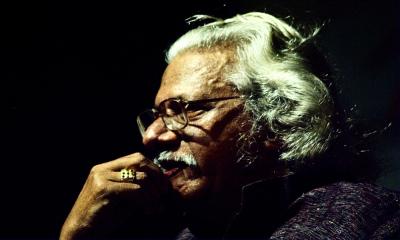
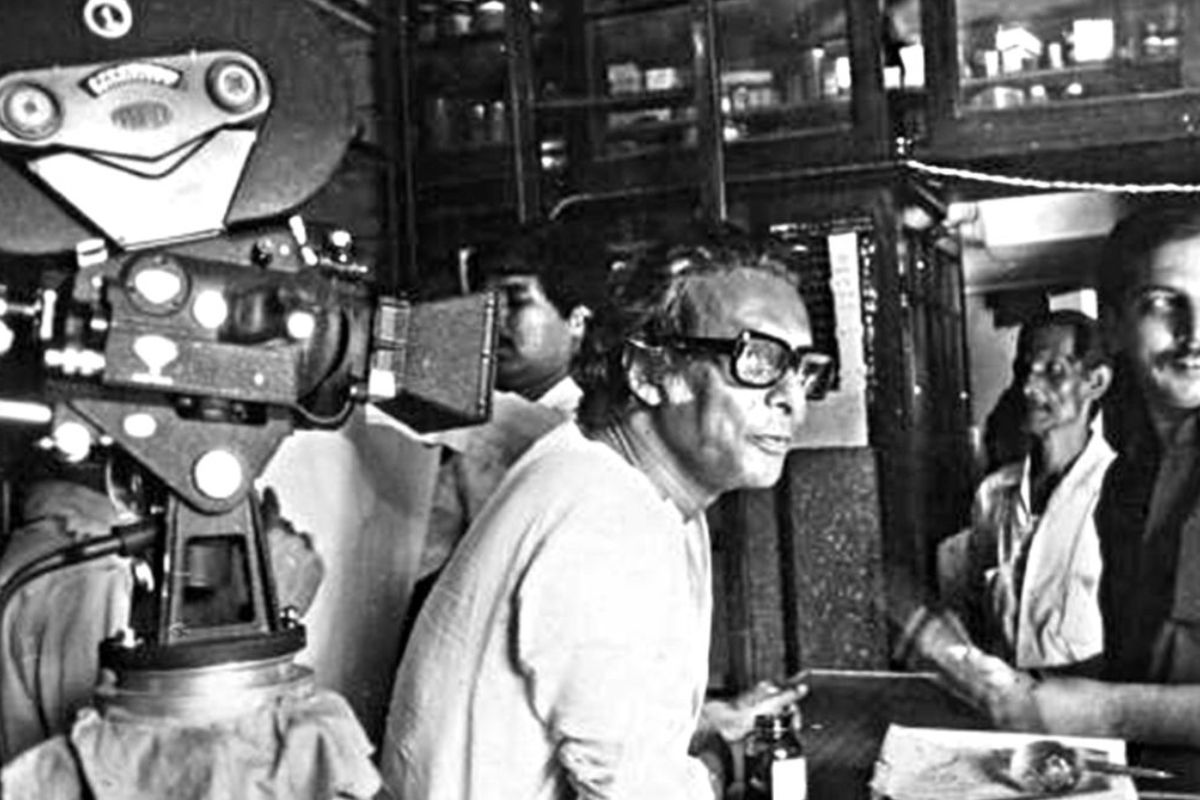
On 14 May, we celebrate the 103rd birth anniversary of Mrinal Sen, one of the most important filmmakers to emerge from the Indian subcontinent. Born in 1923 in Faridpur, now in Bangladesh, Sen would go on to become one of the central figures of world cinema. Alongside Satyajit Ray and Ritwik Ghatak, he transformed Bengali filmmaking into one of the most intellectually vibrant traditions in film history. Yet Sen was always the most restless of the three. If Ray observed society with humanist precision, and Ghatak mourned the wounds of Partition, Sen confronted the political crises of his time with urgency and doubt. Sen did not arrive in cinema through film school. He studied physics at Scottish Church College in Calcutta. Like many young people of his generation, he was drawn to leftist politics and to the belief that art should engage with the world rather than escape from it. He read deeply, especially on film theory, and gradually came to see cinema as a way of thinking. A film, for Sen, was not just a story. It was an argument.
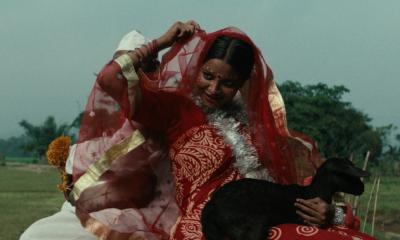
His early films attracted little attention. But in 1969 he made Bhuvan Shome, and everything changed. The film tells the story of a stern railway official who experiences an unexpected transformation after meeting a spirited young village woman. The tone is playful, ironic, and deeply humane. Made on a modest budget, Bhuvan Shome is often credited with launching Indiaন New Wave. It announced the arrival of a filmmaker willing to experiment with form while remaining emotionally accessible. Yet the true measure of Mrinal Sen lies in the films he made in the 1970s. This was a period of extraordinary turbulence in India, especially in Calcutta. There were food shortages, unemployment, and political violence. The Naxalite movement drew many young people toward revolutionary politics, while the state responded with force. Sen did not watch these events from a distance. He turned them into cinema.
His greatest achievement from this period is the Calcutta Trilogy: Interview (1971), Calcutta 71 (1972), and Padatik (1973). These films are among the boldest works ever made in Indian cinema.
Interview begins with a deceptively simple premise. A young man has a crucial job interview but cannot find a Western suit. His desperate search becomes a sharp critique of colonial hangovers and middle-class anxieties. Calcutta 71 moves across different time periods, linking stories of poverty and privilege to show how inequality reproduces itself generation after generation. Padatik follows a political activist in hiding. Confined to an apartment, he begins to question not only the society he wants to change, but also the assumptions of his own political movement.
What makes these films so compelling is their refusal to provide easy answers. Sen was a political filmmaker, but he was never doctrinaire. He distrusted certainty. He understood that every ideology, including one’s own, must be subjected to criticism. His films attack state violence and bourgeois hypocrisy, but they also ask uncomfortable questions of the left and of the educated middle class to which he himself belonged. This self-questioning shaped Sen’s cinematic style. Influenced by Bertolt Brecht and Jean-Luc Godard, he often broke the illusion of realism. Characters speak directly to the camera. Documentary footage interrupts fictional scenes. Editing becomes abrupt and jagged. Sound jars rather than soothes. These techniques keep viewers alert. Sen wanted us to think, not merely to consume. But it would be a mistake to see Mrinal Sen only as a political filmmaker. At the heart of his work lies a profound concern for ordinary people and the hidden moral tensions of everyday life.
Ek Din Pratidin (1979) begins with a small event: a working woman fails to return home one night. Her absence slowly exposes the dependence, fear, and hypocrisy within her family. Akaler Sandhane (1980) follows a film crew making a movie about the Bengal famine of 1943, raising difficult questions about whether suffering can ever be represented without being exploited. Kharij (1982), perhaps Sen’s most devastating film, tells the story of a child domestic worker who dies in his employer’s home. The tragedy is not sensationalized. Instead, Sen focuses on the quiet moral evasions that follow. The child is dead. The middle-class family is shaken. Neighbors express sympathy. Life gradually returns to normal. That is what makes Kharij so disturbing. Sen shows how ordinary people learn to live with injustice, not because they are monsters, but because they are accustomed to looking away.
This is one of the central themes of Sen’s cinema. He was fascinated by the distance between what people believe and how they actually live. His films return again and again to middle-class respectability, exposing the compromises that sustain it. He understood that political crises are not created only by governments or institutions. They are also rooted in everyday habits of denial. There was a rare honesty in this perspective. Sen never placed himself above the society he criticized. He knew he was implicated in the very structures he examined. His films are sharp, but they are never self-righteous. They question the world, but they also question the filmmaker.
Mrinal Sen received many honors during his life, including India’s highest film award, the Dadasaheb Phalke Award, and international recognition at festivals around the world. But awards tell only part of the story. His real achievement lies in the way he expanded our understanding of what cinema can do. He showed that film can be politically engaged without becoming simplistic. It can be intellectually rigorous without losing emotional force. It can challenge audiences without sacrificing humor, tenderness, or human complexity.
Sen died in 2018 at the age of ninety-five. Yet his films remain strikingly relevant. Economic inequality continues to shape millions of lives. Young people still struggle with disillusionment. Democracies remain vulnerable to authoritarian impulses. The questions that animated Sen’s work have not disappeared. What does it mean to live ethically in an unjust world? How should one respond to suffering? When does silence become complicity? Mrinal Sen never claimed to have definitive answers. What he offered instead was a cinema of inquiry. A cinema that provokes, unsettles, and demands reflection.
On his 103rd birth anniversary, revisiting Mrinal Sen means returning to a filmmaker who believed that cinema should disturb our certainties. His camera was restless because his mind was restless. He looked at history not as something distant and complete, but as a living force shaping the present. That is why his films continue to matter. They remind us that cinema is not only a medium of stories. It is also a way of thinking, questioning, and confronting the world we inhabit.