
Bidhan Rebeiro, Translated by Md Rabbi Islam
Published: : April 23, 2026, 11:54 AM
-20260423055424.jpg)
“The narrative of ‘Pather Panchali’ is profoundly indigenous. Yet, much remains to be discovered even in things close to us. One does not gain entry into every corner of the lives of people even where one has lived since birth. The rural Bengal depicted in ‘Pather Panchali’ must be seen anew, as if walking down an unknown road. The merit of the writing is such that nothing feels new; it feels incredibly authentic. There is no attempt to dress up cheap tinsel to charm the mind with high-flown words. The book stands on the strength of its own truth. In this book, I have found the true taste of a story. Nothing was learned from it, but much was seen that had never been seen this way before. In this tale, trees, paths, men and women, joys and sorrows—all have been projected at a distance from the daily environment of our modern experience. Something new has been found in literature, yet it is as clear as a long-familiar thing.”
—Rabindranath Tagore
“This is a cinema that flows forward with the majesty and serenity of a great river. Humans are being born, living their lives, and eventually embracing death without any discordance. Ray paints his pictures in such a way that they evoke profound emotion in the viewer's mind. How did he achieve all this? There is no chaos in the cinematographic technique, nothing irrelevant; herein lies the hidden secret of Satyajit’s excellence.”
—Akira Kurosawa
The novel Pather Panchali is Bibhutibhushan Bandyopadhyay’s first novel, published on October 2, 1929. And the film based on this novel is Satyajit Ray’s debut cinema, released on August 26, 1955. Both have transcended time with equal mastery. One successfully etched the intertwined relationship between nature and humanity into the Bengali psyche once again; the other embodied Bengali rural life with sheer finesse and delivered it to the world stage. Although a director like Truffaut walked out of the hall in some irritation after watching a portion of the film—the renowned French auteur could not truly grasp that day the depth of emotion with which Bengalis viewed, and still view, Satyajit’s Pather Panchali. It is much the same with the novel. Otherwise, how could Rabindranath himself exclaim, “Something new has been found in literature”?
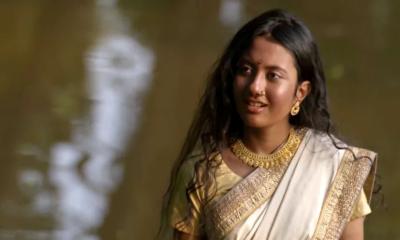
A village somewhere, named Nischindipur. There stands the small thatched house of the ordinary householder Harihar. Living in that house is Harihar’s distant sister, Indir Thakrun. Harihar’s six-year-old daughter Durga calls her Piti. Harihar’s wife is Sarbojaya. She is pregnant for the second time. Moving a bit further, we see a new guest in the family. He is named Apu. Harihar’s world revolves around them. Dense foliage all around; a bamboo grove a little distance from the courtyard. Its rustling sound. A sparrow perched by the veranda. The wonder of Harihar’s infant son, who hasn’t yet learned to speak, watching that bird. All these begin to become our own. We start to feel how familiar they are, how close. we find happiness in the small joys of their lives. We feel the kitten Durga keeps by the hearth in her aunt’s porch is our own. Or when we see in the film Apu and Durga going to see the train through the middle of the kaash flowers, we too become their playmates in that silent noon sun. When Indir Thakrun, the aunt of these two children, dies, our hearts grow heavy. Apu’s loneliness clings to us too when his sister Durga passes away. Satyajit makes this death slightly distinct from Bibhutibhushan’s version. On a stormy night, we see the precarious state of the household deity Ganesh. The storm’s fury crashes against the window. It is as if death is repeatedly trying to enter the house by unsettling the deity. In the end, death triumphs. We too are left stunned by the grief of Sarbojaya losing her daughter. Especially when Satyajit shows the next morning—everything in shambles, broken branches lying in the courtyard, trees uprooted against the wall—as if it were a symbolic form of Sarbojaya’s loss. Everything is devastated; a heavy, suffocating silence all around. Through nature, we see the reflection of little Apu’s mind across the screen.
Following Rabindranath’s cue, it can be said that there is nothing to learn from this novel; there is only seeing and feeling. In giving cinematic form to the vast canvas across which Bibhutibhushan placed his characters in three parts, many characters had to be reduced. The stories of Indir Thakrun’s marriage and widowhood, or the cruel tales of Biru Ray’s band of club-wielding bandits (thangare), had to be omitted. Yet, both can be placed side by side, as if one is the reflection of the other—nothing but a change of medium. We shall conduct a brief discussion here on how much meaning these two works carry in our urban life and how wide they open the windows of memory and emotion.
Though the capital city is several centuries old, even a few decades ago, plows used to run across various lands here; tilling was a regular occurrence. Those paddy fields or canals full of fish haven't vanished that long ago. Therefore, it is known to all that elements of rural life were quite prevalent in the capital as well. At this moment, when the main city is filled with traffic jams, smoke, rows upon rows of concrete matchboxes, and playgrounds have almost vanished—when water bodies are in the clutches of land grabbers—how much does a novel or film like Pather Panchali make us nostalgic or surprised? We would say these two works will certainly surprise this generation; however, even if they don’t like it, much like François Truffaut, we see no reason to be shocked. But for those from two or three generations ago, Bibhutibhushan or Satyajit’s creation will not surprise, but rather move them to nostalgia.
The visual imagery created in the novel by the dark, deep green, shiny new leaves of the taro patch, or the deserted sandbank at the mouth of the Ichamati, the howling wind on that sandbank on a moonlit night, and the swaying clusters of kaash flowers—or the imagery presented in the film through the croaking of frogs before the rain, dragonflies hovering on water-spinach stalks, the water hyacinths in a stagnant pond, and the thick white kaash forest by the railway line—does not harmonize with our urban life. Rather, one must seek past experiences, the memories of days left behind by the people living in this city. If dust has gathered on those memories, reading the novel or watching the film will clear it, and a melancholic emotion of nostalgia will take hold. It goes without saying that the urbanites of this generation do not have such memories; hence, a question remains as to how much this simple story can hold their interest. However, those of the same age as Apu and Durga might find themselves curious about rural life.
After the book Pather Panchali was released, a reception was held for Bibhutibhushan by the Sahitya Sebak Samiti. There, Acharya Suniti Kumar Chatterjee said, ‘I have been a person of Kolkata all my life. I cannot claim such a lifelong acquaintance with the rural nature and village life of Bengalis. But I feel a certain tenderness for it, there is no mistake in that. And I feel a sense of identity with the Apu of Pather Panchali as a Bengali child.’ Urban people like Suniti Kumar can feel tenderness for Pather Panchali, but there is great doubt whether they can claim an identity with the Bengali child. Because the Apu and Durgas of the twenty-first century do not have fields and meadows; their sky is hidden behind tall concrete buildings. The leisure or opportunity to stroke the kaash flowers and go to see the train unnoticed by anyone on a sultry afternoon does not exist for the Apu and Durgas of this era. What exists is otherwise known as Digital Bangladesh. Amen.
References
First Published: October 29, 2010, Daily Ittefaq