

Published: : August 27, 2026, 10:12 PM
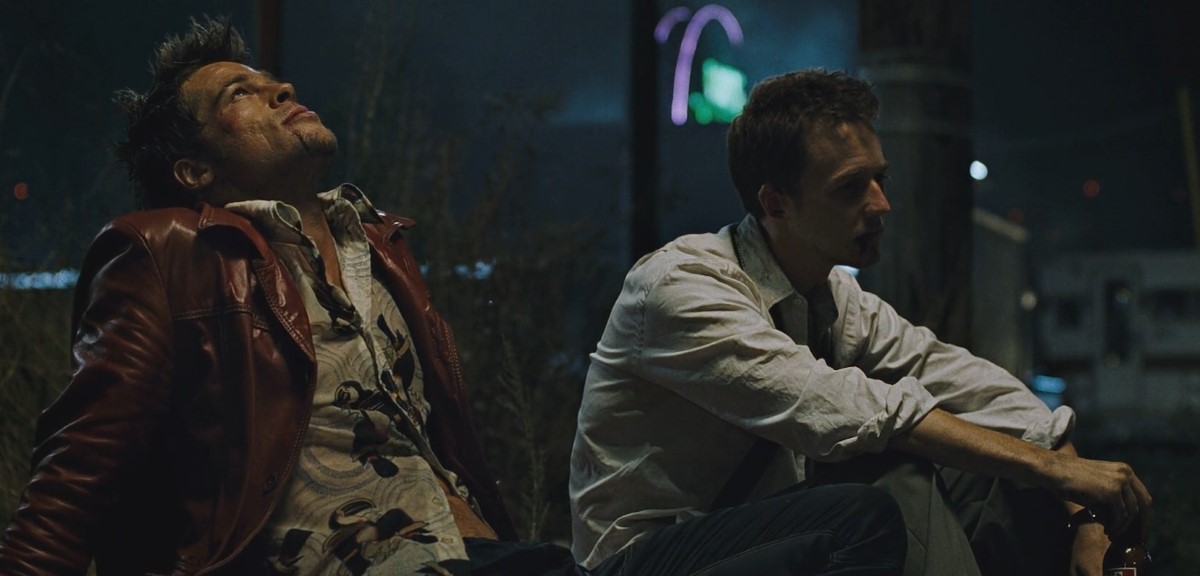
There is something deeply unsettling about watching a man find peace in places where he does not belong. Early in David Fincher’s Fight Club (1999), the unnamed narrator walks into a support group for men suffering from testicular cancer. He is not sick. He has not lost anything physical. He is simply a man who cannot sleep and cannot understand why his life feels empty. However, among strangers who openly discuss their pain, he experiences something he has been unable to find anywhere else: emotional release. When Bob, a former bodybuilder whose body has been affected by steroid abuse and illness, holds him and cries, the narrator finally breaks down. That night he sleeps peacefully. This scene is easy to overlook because it comes before the fights, the rebellion, and the arrival of Tyler Durden. But perhaps it is the most important scene in the entire film. Before Fight Club becomes a story about violence, it becomes a story about a person who has become a stranger to himself.
The film is often remembered for one sentence: “The first rule of Fight Club is: you do not talk about Fight Club.” The line has become one of the most recognizable movie quotes of all time. However, the real meaning behind the rule has very little to do with secrecy. It is about everything people refuse to admit. Their fears. Their frustrations. Their loneliness. Their desire to become someone else. The first rule of Fight Club was never really about the club. It was about the parts of ourselves we try to hide. The narrator’s biggest problem is not that he lacks success. In fact, by conventional standards, his life appears perfectly acceptable. He has a stable corporate job, a comfortable apartment, and the financial ability to buy whatever he wants. Yet he feels completely disconnected from his own existence.
This is where Fight Club becomes more than a film about one troubled man. It becomes a criticism of a society that encourages people to build identities through consumption. The narrator does not simply buy furniture from catalogues because he enjoys decoration. He believes these objects can tell him who he is. His possessions become a substitute for personality. The film understands something uncomfortable about modern life: sometimes people are not unhappy because they have too little. Sometimes they are unhappy because they have spent years chasing things that were never meaningful to them. The narrator’s life is filled with objects but empty of genuine connection. He is not living as himself. He is performing a role that society has already written for him.
Then comes Tyler Durden. Tyler enters the story as everything the narrator wishes he could be. He is confident, fearless, unpredictable, and completely uninterested in the rules that control ordinary life. While the narrator carefully follows expectations, Tyler rejects them without hesitation. He appears free from the fears and limitations that define the narrator’s existence. This is exactly why Tyler is such a fascinating character. He represents a fantasy that many people secretly understand: the fantasy of throwing everything away and finally becoming someone different. He is the voice that tells the narrator he does not have to accept a meaningless life. He offers rebellion as an escape from emptiness.
However, this is also where the film becomes much more complicated. A shallow reading of Fight Club sees Tyler as a symbol of liberation. A deeper reading recognizes that Tyler represents the danger of confusing destruction with freedom. Tyler criticizes consumer culture, but he eventually creates another system built on obedience and control. He rejects one form of authority only to establish another. The people who follow him believe they are escaping society, but they slowly surrender their individuality to him. The film’s irony is that Tyler’s greatest enemy is not the system he fights against. It is his own inability to understand freedom without domination. The film does not simply celebrate rebellion. It questions what happens when rebellion becomes another form of control.
Another important aspect of the film is its exploration of masculinity. The men who join Fight Club are not simply looking for an excuse to hurt each other. They are searching for a place where they can feel something. Their everyday lives have reduced them to employees, consumers, and anonymous faces in a crowd. The fight becomes a strange form of communication. These men struggle to express vulnerability, fear, or insecurity, so they express themselves through physical pain instead. The basement becomes a place where they temporarily escape their social identities. Yet the film does not present this as a perfect solution. The violence provides a temporary feeling of control, but it does not solve the deeper problems these men are facing.
Bob is perhaps the clearest example of this conflict. His body represents the collapse of traditional ideas of masculinity. Once a symbol of physical strength, he becomes someone dealing with illness and vulnerability. Yet it is through vulnerability that the narrator first experiences genuine human connection. This creates one of the film’s most important contradictions: the thing these men fear most, weakness, is actually what allows them to connect with others. Their desire to appear strong prevents them from accepting their own humanity. Fight Club explores the uncomfortable idea that emotional honesty may require more courage than physical strength.
The famous rules of Fight Club reveal this same contradiction. “The first rule of Fight Club is: you do not talk about Fight Club.” The rule represents silence. The narrator spends years unable to talk honestly about his unhappiness. He hides behind his job, his apartment, and his routines. He creates an entire world around himself because confronting his own emptiness feels impossible. The fight club is not just a physical place. It is a psychological space where suppressed emotions are allowed to exist. The real fight is not between two men punching each other in a basement. The real fight is between the person someone has become and the person they believe they should be.
This is why Tyler Durden remains such a powerful character. He represents the narrator’s desire to escape his own limitations. But escape is not the same as growth. Running away from yourself does not automatically lead to discovering yourself. The tragedy of the narrator is that he searches for freedom by rejecting himself. He believes the solution is to become someone else, but eventually he must confront the fact that the person he created is also destroying him. The film’s message is not that people should abandon society, reject responsibility, or embrace chaos. It is something far more difficult: people must honestly face themselves.
Fight Club remains relevant because the questions it raises have not disappeared. How much of our identity is actually our own? Are we living according to our desires or according to expectations placed upon us? What happens when people feel invisible for too long? The first rule of Fight Club says that you do not talk about Fight Club. But perhaps the deeper rule is this: do not lose yourself while trying to find freedom. Because the greatest fight is not fought with fists. It is fought inside the human mind, between who we are, who we pretend to be, and who we are afraid to become.
Md Rabbi Islam is a sub-editor of Cut to Cinema. He can be reached at [email protected].
Send your reviews, articles, and pitches for Cut to Cinema to [email protected]. Check out our submission guidelines for more details.