
Published: : February 7, 2026, 09:10 AM
-20260207031055.jpg)
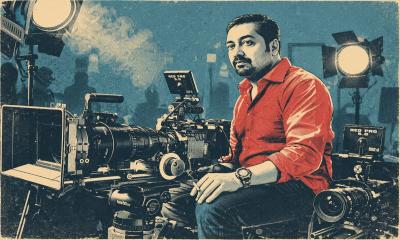
After the remarkable success of his debut feature, Hawa (2022), Mejbaur Rahman Sumon has directed Roid, scheduled for release in 2026. Before its domestic release, the film will be showcased at several international film festivals. On behalf of Cut to Cinema, Bidhan Rebeiro, editor, spoke with Mejbaur Rahman Sumon about his new project.This interview was published in Cut To Cinema January 2026 issue (Vol 1 No 10).
This film, Roid, is completely different from your first feature film, Hawa. Where did you get the story for this film?
Honestly, the journey of finding the story for Roid was a bit different. When I was making Hawa, I was actually looking for a story about the lives of Gypsies or the Bedey (river nomads) of our country. It was during that search that I went to the sea, and coincidentally, Hawa was created. However, the context of Roid and the space I wanted to capture will be clear to the audience only when they watch the movie; it is difficult to explain the whole thing in a trailer.
The core essence of the story I wanted to capture is a primal tale. If we look at it from the perspective of Abrahamic religions or known religious narratives—it is the story of Adam and Eve. The punishment of descending from heaven to earth and that primal fruit or Gandhom—which we see as the earliest sign of love between man and woman. However, if we think beyond theological interpretations, that 'fruit' is not just a fruit; it becomes a symbol of human desire, physical needs, or the birth of something new.
The connection between this theoretical thought and the real source of the story happened through my mother. ‘Sadhu’ and his ‘mad wife’ used to work at my grandmother’s house. Sadhu used to graze cows. For some reason, to look after the land or the fish project of my grandmother’s estate, arrangements were made for them to stay a little distance away from the village. The story basically starts from there.
One afternoon during the Corona period, while having lunch, my mother told me an incident about the lives of Sadhu and his wife. In that incident heard from my mother, I saw a shadow of a surreal world in Sadhu’s life. I had seen Sadhu, his wife, and their house in reality, but the surreal aspect of their lives that my mother described was unseen to me.
That was when I sat down to write the script. While writing, I found the connection between this story and myths or religious narratives.
I don't know for sure why this happens. But whenever I look for a story, elements of myths, Puranas, or folklore perhaps work in my subconscious. This happened in my previous works like Angurlota, Paruler Din, Superman, or Kothay Palabe Bolo Rupban—it happened in every case. Perhaps the influence of stories heard from grandmothers or aunts in childhood has remained within me. The unique style of telling ‘Kichcha’ (tales) in our region also influences me greatly.
This influence also comes into the dialogue of my cinema. For example, there is a dialogue in the trailer—‘What is your name?’, the answer comes—‘My name is Sadhu’s wife’. This matter made me think deeply. In our social reality, women often do not have a name of their own; she is known by the identity of her father, husband, or child. In reality, too, no one knew Sadhu’s wife’s real name; even my mother used to call her ‘Sadhu’s wife’.
So, all in all—memories heard from my mother, the influence of childhood folktales, and the surrealism embedded within me—it is through a combination of these that I actually found the story of Roid.
There is a touch of surrealism in your films. It was in Hawa, and it is in Roid too. Why does the surreal attract you?
It is actually difficult to say specifically why surrealism draws me in. Because I have never thought about the matter in this way before—what exactly attracts me or why. However, analyzing it now, it seems there could be several reasons behind it.
First, I studied Fine Arts. There, for academic necessities, I had to familiarize myself with various art forms starting from the Renaissance or even earlier periods to modern Dadaism, Cubism, Surrealism, Abstract, or Expressionism.
Second, during university life, I came into contact with various types of books and authors. The writings of Franz Kafka, Albert Camus, Haruki Murakami, or our very own Shahidul Zahir inspired me deeply. Reading these types of authors probably helped me enter the world of surreal thought.
Looking back even further, I used to write songs since my school days. At that time, Lalon Sai, Kabir Suman, or Moheener Ghoraguli influenced me immensely. It was from them that I found the materials to think differently through lyrics or the words of songs.
Humans are actually formed through their surroundings. Truth be told, to me, even this visible reality or realism seems like a vast surreal world. When I close my eyes and try to understand nature or this world, a haze is sometimes created regarding my own existence—do I even exist, or do I not! The wants and needs, joys and sorrows, or pain of ordinary life—searching for the deeper truth within these seems more urgent and joyful to me than these things themselves. My mind remains always curious to know that deep truth.
And I feel that the surreal world helps me go into the depths of that truth. Probably for this reason, I am repeatedly attracted to such stories and prefer telling stories in this way.
What was the biggest challenge during the shooting of Roid?
Throughout the entire process of making Roid, we had to go through multifaceted challenges. This struggle started not from the shooting floor, but from the stage of scriptwriting. The biggest challenge was creating a distinct world for Sadhu and his wife.
While writing the screenplay, I told my team—I want to show a village on screen that, upon seeing, the audience will feel is a village in Bangladesh, yet they have never seen this village before. Somewhat familiar yet unfamiliar, an unseen Bangladesh. I actually wanted to create a surreal world or a ‘new planet’ for Sadhu and the mad woman. In this vast settlement, only the two of them are residents; everyone else seems like visitors from outside this planet.
To bring out this metaphorical visual, I needed a location that wouldn't just be ‘beautiful’; it had to have primitivity. My requirement was—river, lake, hills, green grass, and vegetation all had to be in the same frame. In a flat land country like Bangladesh, finding such a combination—where hills and water bodies merge with the village—is extremely difficult. Here, hills mean hilly regions, where such villages are not usually seen.
My team’s location manager, Bablu Bose, accomplished this impossible task. He searched for locations for about a year and a half, and finally, we found the desired place. However, the battle didn't end after finding the location. Although we liked the place, there were no trees or vegetation there. Being hilly and sandy soil, crops or trees did not grow there. But for the sake of the story, we had to build the set right there.
Compelled, we brought fertile soil from outside by truck. Then, over a period of about six months, fifty thousand trees were planted there, and Sadhu’s house was built. Apart from this, the conventional challenges of actors mixing with village people or getting used to their lifestyle to become the characters were there, of course. But in my opinion, dumping soil on that arid land, creating a jungle, and building a completely new habitable world was the biggest challenge for the Roid team.
Given the way Bangladeshi cinema is progressing, where do you think this industry will reach in the next five years?
What exactly will happen in five years is not possible to say by predicting like a soothsayer. However, when we go through a process or a time, we often don't sense the internal changes very much ourselves; that is normal. But I firmly believe that our cinema is currently passing through a wonderful time.
Our young filmmakers—those who are working now and those who will come in the future—have started to introduce our cinema to the world. Our films are now going to big international festivals. At the same time, a renewed interest in cinema has been created among the country's audience. The industry that was once nearly dead or on the verge of being lost is being revived—this is truly joyous.
I think that in the future, a distinct position or ‘Identity’ of ours will be created on the map of world cinema. The world will sense that there is a strong existence called ‘Bangladeshi Cinema’ and will discuss our work. I believe that promising day is not very far, but rather very near.
Bidhan Rebeiro is the editor of Cut to Cinema.
Send your reviews, articles, and pitches for Cut to Cinema to [email protected]. Check out our submission guidelines for more details.