
Published: : January 28, 2026, 11:28 AM
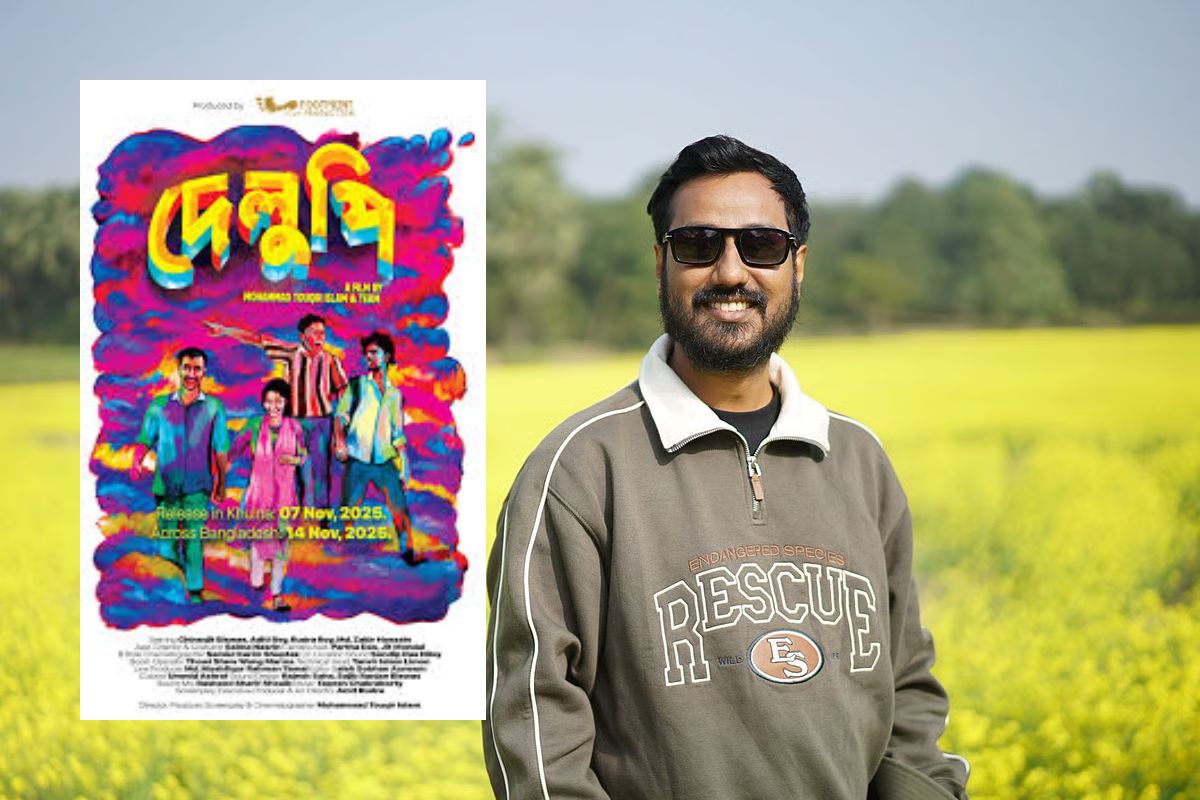
Mohammad Touqir Islam, director of Delupi, Shaaticup and Sinpaat, gave an exclusive interview to Cut To Cinema. The interview was conducted by Md Rabbi Islam.
In your work, you use the concept of “Fictional Reality” or “Imagined Reality.” Exactly where does this differ from conventional docu-fiction? Do you change reality for the sake of your story, or do you arrange the story to align with reality?
Actually, cinema stands on the foundation of a fictional story. Now the matter is, where do we take the references from—that is the matter. Sometimes an idea comes from our thoughts; sometimes we take the materials for the story from absolute reality, from our own experiences. Again, sometimes we take our story materials from a book, or another movie, or any medium, or from nature. So, in our film—in ‘Delupi’—what happened specifically is that we actually took the materials more from reality, from real life, from the times. So, this is where the matter of docu-fiction or documentary lies. I mean, what happens in a documentary or docu-fiction is that reality itself is expressed, reality itself is shown. In our case, actually, this is fiction; it’s not that every event happened exactly this way here. Many events, perhaps, we wrote fictionally ourselves. But when referencing, these match up very well with reality; they are very connecting with reality. As a result, it is seen that people can connect very much with the reality.
In ‘Sinpaat,’ you cast a real-life former criminal as an actor. Again, in ‘Delupi,’ you worked with flood-affected people. How difficult is it ethically to ask people to re-enact old wounds of their lives or memories of crimes in front of the camera?
Actually, after a certain time, our life experiences or the events that happened in our lives—these all just become an experience, become a memory. So, eventually, we actually express that—that it happened like this or this matter occurred. Then, actually, we want to express this of our own accord. So, in that case, I feel that there isn’t much of a trouble. Because it’s not like we are working with such a wound that he actually didn’t want to bring forward, that he didn’t want to speak about. We, however, everyone want to express our own lives, and we think that our life is much bigger than a movie or that it is possible to make thousands of movies with our lives. So, from that place, I still haven't felt in any way... ethically in any place that I am pressuring anyone to do the work or that I am not doing right ethically.
According to critics, ‘Delupi’ shows that even if power changes, exploitation does not end; it only changes hands. Is this movie a warning for the young generation that they are going to get trapped in the same old governance system again?
No, actually, why would this be only for the youth? We have faced this; we have found this in our history; We ourselves are the proof of this. We are repeatedly going through the same kind of matter, or have gone through it. So, now—I mean—we can overcome this only when we carry our history with us, and the mistakes we made, we won't do those in the future—only then will these solutions actually come about.
You shot this movie amidst the floods of Paikgachha. Is the source of the film’s main intense tension the political crisis or the climate crisis? Do you see these two disasters as separate, or do you consider them intertwined with one another?
I view both as our crises. Number one is the disaster that occurred—this flood, and the terrible way people lost their homes, their own assets, to lives... so much was lost. To survive this disaster, our unity, all of us working as one, is just as important; Our working as one... people can work only when they are united, when they remain in a politically strong position. If we are not right politically, if our unity is not right, if we cannot stand together during national crises, during various disasters—then at the end of the day, both crises will damage us together, and we won't be able to overcome any crisis.
What kind of difference do you expect between the reaction of the common audience in the village and the reaction of the audience at international film festivals?
The reaction among the common audience in the village... what is most interesting and a matter of achievement is that—when we premiered in Kalinagar, the people there held hands and prayed for me, gave me blessings. I haven’t received this in any film like that, actually. I mean, this kind of prayer from people... they are praying from the heart. Those people, they were in such a backward place that people didn't recognize them. People didn't know them, didn't know—who they are, where they came from. But the fact that this film is highlighting their identity to people, that they are being talked about everywhere—for this, they became very overwhelmed. That their portrayal has come up in the film, I have seen a kind of reflection of this in the audience's reaction! I haven't been able to reach the international audience yet. The film is going to Rotterdam first; the festival starts in January. So, once I go to this festival, then I will be able to say what the international audience's reaction is. I mean, ‘Delupi’s’ international journey is starting from here, basically.