Published: : August 8, 2026, 03:28 PM
The City as a Living Character
When a specific city becomes the repeated focus of cinema, it ceases to be a mere backdrop. Instead, it transforms into an active participant in the narrative—endowed with its own psychology, memory, and socio-cultural impact. The seismic shifts of history are often mirrored most vividly in these urban character studies.
In Roberto Rossellini’s Rome, Open City, the post-war crisis and psychological fracture of Rome were powerfully laid bare. Decades later, Federico Fellini used that very same landscape in La Dolce Vita to map the existential emptiness of modernity and the disillusionment of luxurious living against an ancient historical canvas.
Similarly, the anxieties of the middle class, social unrest, and political friction of Kolkata found their voice in Satyajit Ray’s Mahanagar and Mrinal Sen’s Calcutta 71. In the late nineties, Ram Gopal Varma captured Mumbai’s dreams, struggles, immigrant anxieties, and the gritty realities of the underworld in Satya.
In works of this calibre, a city frequently becomes a microcosm of a nation—a metaphor for dreams, conflict, and decay. Filmmakers who view the same city through distinct lenses cultivate a form of "urban authorship," where geographical boundaries and deeply personal philosophies intertwine. Even the auditory landscapes—the iconic clang of Kolkata’s trams, the chaotic roar of Rome’s streets, or the relentless rhythm of Mumbai’s local trains—shape a unique identity for the city, translating urban noise into a lived, breathing human experience.
The Landscape of Human Journeys
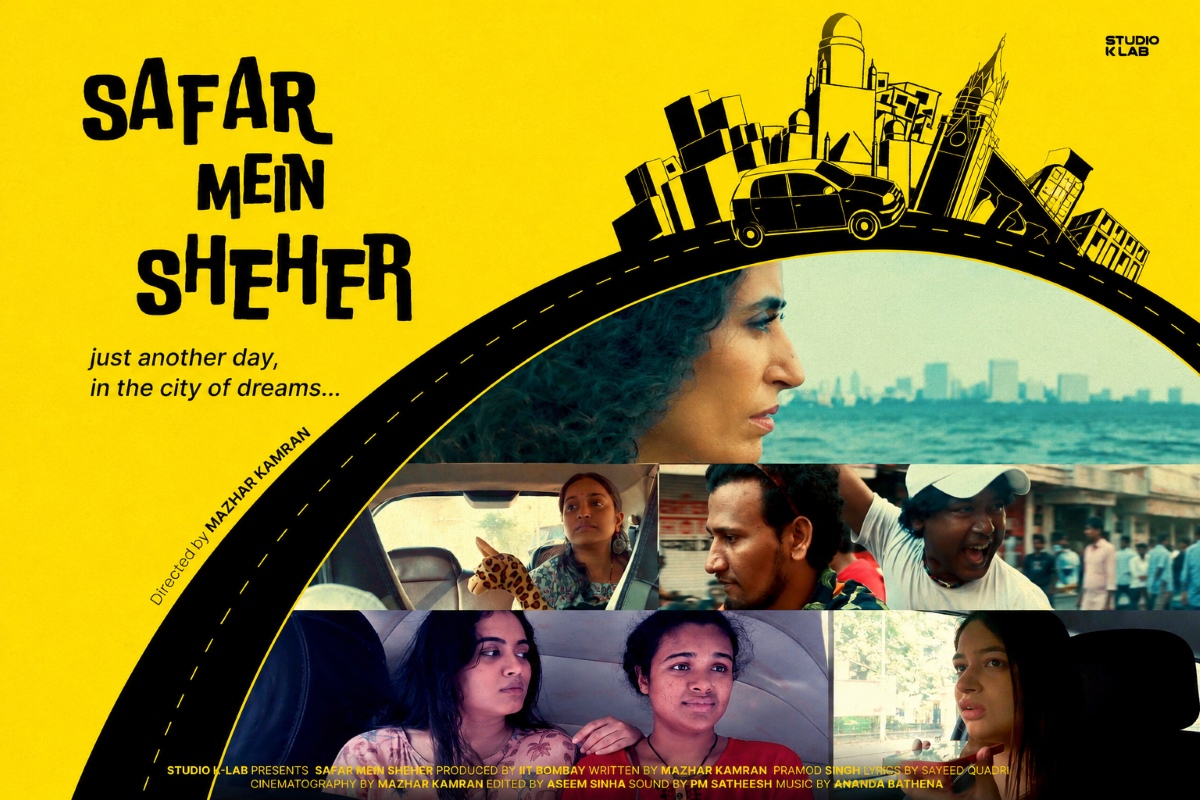
Mumbai has served as the canvas for countless films, each capturing its varied faces and systemic conflicts. The latest addition to this cinematic lineage is Safar Mein Seher (The City in a Journey), directed by Mazhar Kamran. What sets this film apart is that Mumbai is never treated as a passive setting; it emerges as a primary protagonist whose vast heart holds an infinite repository of human stories. Kamran, who also penned the story, opens the film with a striking contrast.
The film opens with an extreme wide shot: the boundless expanse of the Arabian Sea, its waves relentlessly crashing against towering skyscrapers. We see massive concrete blocks, congested roads, and packed local trains. Viewed from a distance, the metropolis appears silent, solemn, and deeply self-absorbed. Over these visuals, a detached, off-screen narrator speaks:
"Twenty-one million people live in this city, and so do I."
The narrator observes these millions, selecting a handful whose stories he is about to unravel. He begins his chronicle with a simple marker of time: "It is now three in the morning."
This voice does not belong to any character within the frame; he is a pure observer. The title translates to The City in a Journey, yet the narrator is a resident, not a traveller. Whose journey is it then?
As this question arises, the screen fills with striking nocturnal imagery: local trains piercing the darkness, busy taxis cutting through illuminated thoroughfares, silent and narrow alleyways, and young professionals working through the night in call centres. Parts of this sleepless city are perpetually in motion. The screenplay, co-written by Kamran and Pramod Singh, beautifully captures this restless energy by tracking a tapestry of diverse lives: a wealthy elderly man wrestling with profound isolation, a domestic helper journeying back to her roots on the city's outskirts, an aspiring filmmaker searching for his artistic voice, a returning NRI woman confronting a fractured family dynamic, and a young female journalist striving to carve out her own space.
The film moves forward not by plot, but through this collective momentum—a shared pilgrimage toward distinct, yet intersecting destinations.
Fragmented Realities and the Existential Void
The narrative brings together an ensemble of profoundly diverse characters whose cultural and economic realities are miles apart. Yet, they are bound by two common threads: their lives are viewed through the prism of Mumbai, and each is on a deeply personal journey. It is a transition within the physical confines of the city that ultimately forces them into the hidden, unexamined recesses of their own consciousness.
Safar Mein Seher consciously rejects the conventional, linear progression of a traditional plot. Here, "story" does not signify a rigid chain of cause and effect; instead, it is an accumulation of small, fleeting human experiences. At first glance, these fragmented lives appear entirely disconnected. Yet, from a philosophical standpoint, it is precisely this fragmentation that reveals a profound, underlying unity.
Every individual story adds a layer of lived experience to the city’s existential fabric. It is a collective consciousness forged from memories, aspirations, and quiet heartbreaks. The city is revealed to be far more than architecture, grid lines, or geographical space—it is a fluid, ever-shifting repository of human memory.
A significant portion of the film unfolds within the tight frames of moving taxis. Through the windows, the vibrant, chaotic facets of Mumbai flash by, while the conversations inside the cab become mirrors reflecting the internal realities of the passengers. Toward the film’s conclusion, several characters serendipitously converge in a local restaurant, steering the film toward an organic climax. There, a stand-up comedian delivers a line that cuts through the film's core:
"Everyone in Mumbai is running around, but no one is arriving anywhere."
The Grammar of Realism: Dialogue and Subtlety
Because the film bypasses traditional structural frameworks, it operates without a standard linear script. Instead, the narrative progresses through brief, sharp exchanges that lay bare personal crises and distinct worldviews. These dialogues do not merely explain individual dilemmas; they expose the complex, often adversarial relationship the characters share with the city itself.
Philosophically, the city is presented as a paradoxical entity—it is the very source of their displacement, yet it holds the quiet promise of their resolution. It is a battleground of human desire where dreams and an immense emotional vacuum coexist.
This existential friction finds its most poignant expression in a quiet conversation involving an elderly taxi driver. A young migrant from a village, looking out at the sprawling metropolis, remarks to him:
"You don't have a home here, and you have nothing left in the village either."
This single sentence distills the profound alienation of urban migration. While the youth intended it as a casual, perhaps cynical jab at the driver's economic vulnerability, the elderly driver’s subsequent silence speaks volumes. It is the echo of an existential void where "home" ceases to be a geographic coordinate and becomes an endless, internal search.
As the driver falls silent, a melancholy score fills the background. Through the window of the moving taxi, the skeletal iron structures of a half-constructed flyover pass by like a harsh, unfinished sketch. This visual imagery combines powerfully with the acoustic layer, generating a profound effect of pure existential realism. These skeletal frames become the visual manifestation of the driver's fractured mind, elevating the scene from a visual observation to a deep emotional experience.
The narrative demands an uncompromising, organic visual language—one that feels as unadorned and authentic as a documentary. Crafting a staged, fictional scene to carry the spontaneous, raw weight of a documentary is incredibly complex. Yet, through the unforced presence of the actors, the colloquial ease of the dialogue, and a dynamic camera philosophy that feels as though it is merely capturing life as it happens, the film achieves a rare, breathing vitality. There is no manufactured melodrama here; the scenes unfold to the natural rhythm of life, successfully bridging the gap between fiction and documentary realism.
The Technical Craft: Light, Edit, and Textures
Safar Mein Seher consciously avoids the tourist-trap iconography of Mumbai—there are no romanticised frames of the Gateway of India or Marine Drive. Instead, the camera wanders into unfamiliar, everyday spaces that capture the genuine pulse and rhythm of the city. A scene set inside a century-old restaurant does not merely evoke nostalgia for a character; it highlights the historical current and heritage of the metropolis. Spaces here are never passive; they are woven into the very soul of the narrative.
The dialogue, penned by Pramod Singh, plays a pivotal role in establishing this authenticity. While primarily written in Hindi, it naturally integrates Marathi and English as the characters require. The subtle shifts in Hindi dialects and accents masterfully signal the regional and socio-economic backgrounds of each character. Even for audiences unfamiliar with these linguistic nuances, the conversational authenticity allows them to appreciate the depth of characterisation Kamran achieves. However, the artistic resonance of the film could have been heightened even further had the director provided slightly more visual cues or contextual backstories for a few of the minor characters, making their arcs even more accessible to the viewer.
The true cornerstone of the film’s artistic success lies in its cinematography. The visual strategies perfectly capture the underlying restlessness and internal conflicts of the characters. The way the film handles the stark contrast between daylight and nightscapes, blending them seamlessly with the shifting moods of the stories, stands as a testament to the director and cinematographer's refined aesthetic sensibilities.
Asim Sinha’s editing further elevates this mosaic structure. He connects seemingly disparate, fragmented vignettes with a fluidity that keeps the pacing natural and cohesive. The shifting perspectives and varying angles captured from within moving vehicles are stitched together seamlessly, avoiding any jarring transitions. Sinha's skill is particularly evident in the extended restaurant sequence near the end. Weaving together fragmented, multi-tonal conversations from different tables while preserving the singular mood and rhythm of the space requires extraordinary restraint and precision. Though there are occasional continuity slips—such as a vehicle’s direction or speed abruptly shifting between cuts during character dialogue—which could have been polished to ensure technical flawlessness, the overall editing remains remarkably strong.
Ultimately, Safar Mein Seher reminds us that the highest calling of cinema is neither to merely entertain nor to instruct pedantically. It is to make us feel a little less isolated within our own imperfections. In Mazhar Kamran, Mumbai has found a filmmaker who refuses to exploit or romanticise the city, choosing instead to inhabit it with profound honesty and tenderness.
In an era where market-driven Indian cinema frequently mistakes deafening noise for creative ambition, Safar Mein Seher chooses to whisper—and in that quiet whisper, it says everything.
Send your reviews, articles, and pitches for Cut to Cinema to [email protected]. Check out our submission guidelines for more details.