Published: : September 27, 2026, 12:33 AM
At the 83rd Venice International Film Festival, I watched a deeply disturbing and heartbreaking documentary built around the shameless genocide that has been unfolding before the world’s eyes for years. Directed by Yuval Abraham and Rachel Szor, the documentary is titled Naza.
At first, I could not understand what the word “Naza” meant. But after the film began, I learned that when Israeli forces kill a suspected individual in Palestine, they use the term “Naza” for the family members and neighbours who are killed along with that person.
Suppose they target one person and kill him, but another hundred people are killed in the same attack. Those hundred dead people are what the Israeli military calls “Naza.” But why should a hundred other people die along with one targeted individual?
The reason is that when the suspected person enters his home to sleep, Israeli forces may destroy the entire building using drones or remotely controlled missiles. Children, women and men are killed indiscriminately. There have even been cases where entire neighbourhoods have been reduced to dust by Israeli forces.
The film is built around a series of interviews with former members and senior officials of Israeli intelligence agencies. Needless to say, their faces have been concealed. Yet they agreed to speak because of their sense of humanity and the burden of their own conscience.
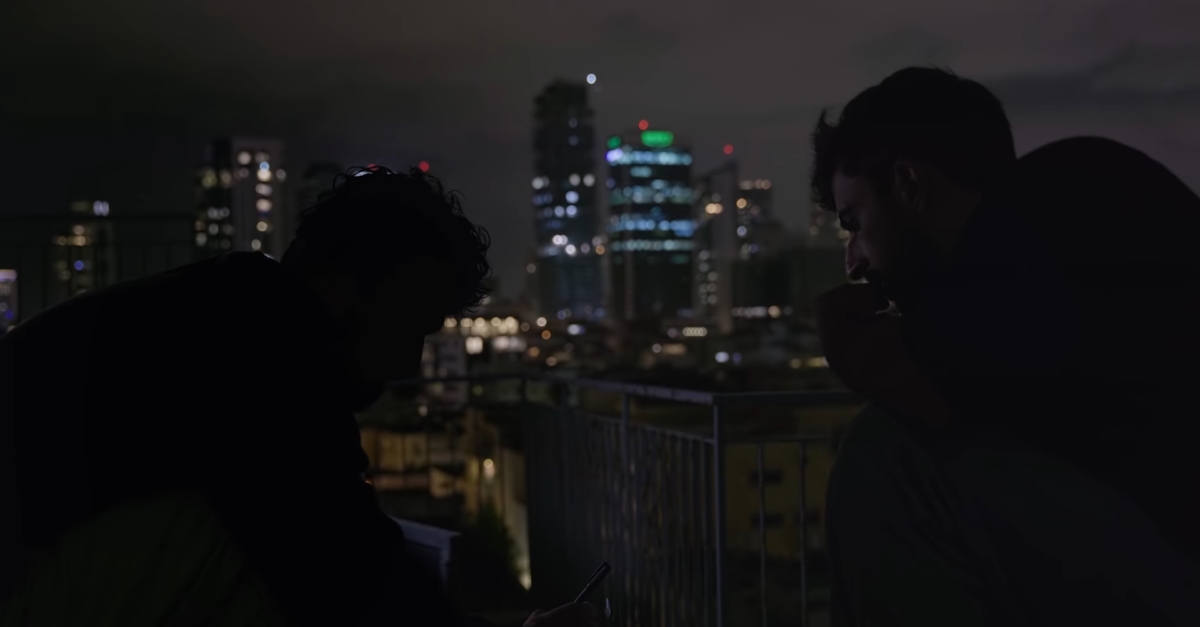
The film was shot at night on the rooftop of a building in Tel Aviv. It reveals how Israel has developed a disturbing system for carrying out what the film presents as the systematic killing of Palestinian civilians in Gaza.
One such system is called “Lavender.” Powered by artificial intelligence, Lavender can monitor the residents of virtually every building in Gaza. It analyses not only phone conversations, but also social media activity and people’s daily movements, allowing individuals to be identified and targeted for killing.
One former intelligence officer says Lavender has an 85 percent success rate in identifying people associated with Hamas or terrorist activities.
The interviewer then asks: What about the remaining 15 percent? If the system makes a mistake, do ordinary people die?
The officer answers, “Yes.”
According to the film, the Israeli forces show no remorse over such deaths. The bodies are often left where they have fallen, without burial. By the following day, dogs may drag the bodies away and feed on them. The film also includes testimony that Israeli soldiers take pleasure in witnessing such scenes.
Another system is called “Where’s Daddy?” It is also powered by artificial intelligence. Through this system, Israeli intelligence analyses patterns of communication and cross-references information among family members to determine when, where and how a target should be attacked.
The film recounts the case of a teenage girl whose communications were used to identify and target her father. The father was killed, and the girl herself was also killed.
The film suggests that Israeli soldiers are systematically trained to see Palestinian Arabs simply as terrorists. In their eyes, people of all ages become potential targets. As a result, they kill people with devastating ease and without mercy.
In the interviews, former officers describe killing Palestinians as something as entertaining to them as playing a video game.
One female officer, who perhaps retained some sense of compassion, says that after a building was bombed, if she saw someone still alive and suffering in the rubble, she would order another bomb to be dropped to finish the person off.
Why did the two directors make such a heartbreaking film documenting Israeli brutality, especially when they themselves are Israeli?
They answer: “We made this film out of a sense of responsibility. As Israelis, we wanted to use the position we have to show that Israel is carrying out genocide in Palestine. We felt it was our duty to reveal this.”
The two directors worked on the film for three years, with support from the British newspaper The Guardian.
The directors say, “Through investigative journalism, this film gave us the opportunity to investigate things more deeply than we could otherwise. It allowed us to look not only at what is being said, but also at what is not being said, at the silences themselves. Breaking that silence is a responsibility we all share.”
Alongside the interviews with former intelligence officers, the film also includes an old television interview with Israel’s current prime minister, Benjamin Netanyahu.
In that interview, Netanyahu is asked what constitutes terrorism. He answers that it is when an attack is deliberately and systematically carried out against unarmed civilians.
The film uses Netanyahu’s own words from his youth to confront him with the consequences of the actions attributed to his government.
Near the end of the film, we see the aftermath of the planned destruction of a Palestinian building. Rescue workers arrive. Cries and screams fill the air. Bodies lie buried beneath the rubble.
A father searches desperately for his children, his anguished cries filling the air.
And that is where the documentary ends.
Thanks to the Venice Film Festival for giving such a powerful film a place in its Official Competition. Naza went on to receive the Special Jury Prize in Venice.
In 2024, Yuval Abraham and Rachel Szor made another film about Israeli occupation of Palestinian territory. It was titled No Other Land. They were joined by Basel Adra and Hamdan Ballal as co-directors.
The film was screened at the 74th Berlin International Film Festival, where it received the Panorama Audience Award for Best Documentary. It later won the Academy Award for Best Documentary Feature at the 97th Academy Awards.
Yuval and Rachel do not make films simply for the sake of making films. They continue to work from a strong political commitment. Through cinema, they are shaking the foundations of powerful states and leaders around the world.
Even the Israeli prime minister and the state apparatus have reportedly sought to silence them. But Yuval and Rachel remain undeterred.
Once again, through their work, they are proving the extraordinary power of cinema.
Bidhan Rebeiro is the editor of Cut to Cinema.
Send your reviews, articles, and pitches for Cut to Cinema to [email protected]. Check out our submission guidelines for more details.