Published: : September 10, 2026, 01:56 AM
During the 1980s, wherever one happened to live in the world, films from the great Soviet cinema of the late 1920s were extremely difficult to see. For many of us, they existed first not as moving images on a screen, but as photographs discovered in books.
I remember going to the city library and searching through the film section. Among books on the French New Wave and Italian Neorealism, there would almost certainly be a volume devoted to the Soviet film movement of the 1920s. As I slowly turned its pages, I could almost smell something beyond the ageing paper—the burning desire for revolution, the dream of equality and the hope of creating an entirely new society.
The extraordinary years following the Russian Revolution, when cinema was not regarded merely as entertainment, film was part of the struggle to educate people, reshape consciousness and build a communist state. The filmmakers of that period seemed possessed by an astonishing creative urgency. They experimented fearlessly with photography, psychology, politics, history, editing, folklore and philosophy. Every frame appeared to be searching for a new way of seeing the world.
The passion of filmmakers such as Eisenstein, Vertov, Pudovkin and Dovzhenko still resonates through our generation and will continue to inspire generations of filmmakers yet to come. Their films emerged from a particular historical moment, but their energy has never been confined to the past. Nearly a century later, they continue to challenge us, disturb us and remind us of what cinema can achieve when artistic experimentation is joined with an urgent belief in changing the world.
Dovzhenko was born in 1894 into a poor peasant family in Sosnytsia, in northern Ukraine. Many of his brothers and sisters died young, and those early encounters with loss stayed with him. Death, family, fertility and regeneration would later return again and again in his films—not as abstract ideas, but as deeply felt parts of ordinary life. His first vocation was teaching. He believed education could challenge ignorance, inequality and national oppression. Even after he left the classroom, he never entirely stopped being a teacher; filmmaking simply became his new way of awakening people and sharing his vision of the world.
Before entering cinema, Dovzhenko served in Soviet diplomatic missions, studied art in Berlin and worked as a political cartoonist in Kharkiv. In 1926, he joined the Ukrainian film organisation VUFKU. After making early comedies and the adventure film The Diplomatic Pouch, he directed the three films that established his international reputation: Zvenyhora (1927), Arsenal (1928) and Earth (1930).
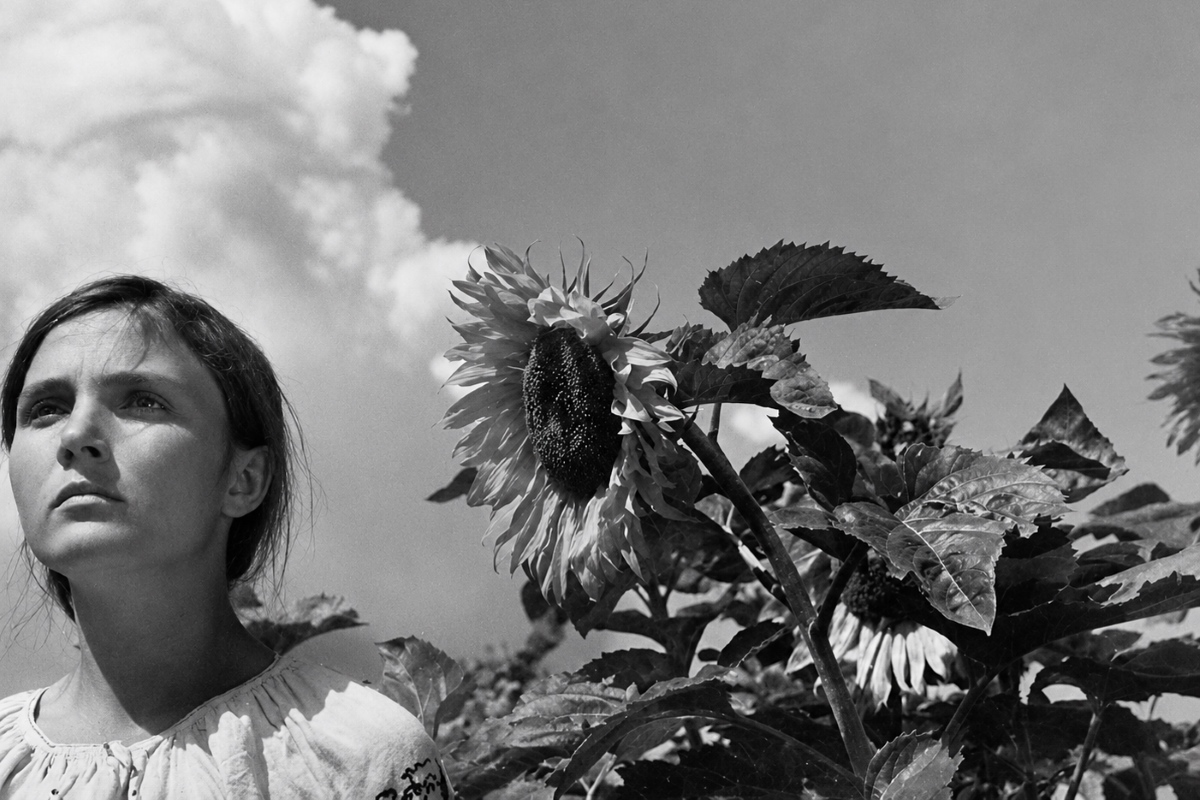
My relationship with Dovzhenko began with a single photograph from Earth: a woman standing before a sunflower. I knew almost nothing about the scene, yet I could not take my eyes off it. It felt like a fantasy—sensual, mysterious and almost indecently beautiful, a kind of pure art-film seduction. Something in that image seemed to contain the whole meaning of the word “earth”: the soil, the body, fertility, desire, life and death. It did not simply make me curious about Dovzhenko; it made me obsessed with cinema. That photograph showed me that a film image could be more than a record of a person or a place. It could carry an entire world within it.
Moving from the still photographs of Dovzhenko’s films to watching them unfold on screen feels like witnessing those images awaken. Suddenly, life begins to flow through them: people walk, bodies labour, trees tremble, wheat bends in the wind and clouds drift across the earth. His cinema possesses the rhythm of breathing—of birth, desire, work, death and renewal. In these moments, Dovzhenko reveals himself as far more than a political activist or a teacher. He was an artist with the rare ability to discover beauty in everything: a human face, a sunflower, a machine, a field after rain. He did not simply photograph life; he saw its hidden poetry and made us feel it.
There was always a fascinating duality within Dovzhenko. As the educated son of a poor peasant family, he belonged to two worlds at once. He understood the traditional life of the village—the soil, harvests, songs, rituals, family stories and authority of grandfathers—but he had also encountered cities, modern education, European art, revolutionary politics and industrial technology. He never completely abandoned either world.
Progress arrives promising liberation, but it also brings machines, bureaucracy, displacement and the possibility that something precious will be lost. Dovzhenko’s cinema repeatedly asks whether society can enter the future without cutting off its roots. His hope was for a benevolent modern world in which human beings, nature and machines could live together harmoniously.
This conflict is at the heart of Zvenyhora. The film travels through nearly a thousand years of Ukrainian history, mixing Cossack legends, foreign invasions, war, revolution, industrialisation and fantasy. At its centre is an old grandfather guarding the treasures supposedly buried inside the mountain of Zvenyhora.
But Dovzhenko’s treasure is more complicated than gold. For grandson, Pavlo, it represents a romantic and nationalist past. And for his Bolshevik brother Tymish, the true treasure is the coal and iron that can fuel the industrial future. The grandfather stands between them as the living memory of Ukraine.
In Arsenal, Dovzhenko narrows his attention to the Ukrainian Revolution and the 1918 uprising at the Kyiv Arsenal. The film begins with the devastation of the First World War and moves through military collapse, political confusion and revolutionary violence. Its hero, Tymish, finally opens his shirt before the enemy and survives repeated gunfire like a figure from folklore. The image declares that the revolutionary spirit cannot be killed, but the film around it refuses to let us forget the suffering created by revolution.
Earth brings this struggle into the village. A tractor arrives to help establish a collective farm, breaking through fences and disrupting the inherited order. Young Vasyl welcomes collectivisation, while his father hesitates. When Vasyl is murdered, his death helps unite the community behind the collective. Yet the political story is only one layer of the film. Dovzhenko’s images of apples, wheat, rain, sunflowers, faces and bodies create another meaning. Human beings die, children are born, fruit ripens and rain falls. Political systems may change overnight, but the earth continues its older rhythm.
Dovzhenko’s own roots were never cut off, even when Stalin effectively separated him from Ukraine. The separation contributed to depression, illness and long periods of creative paralysis. Yet even when he could not physically return home, Ukraine kept returning to him. It appeared in his diaries, war writings and later screenplays, particularly The Enchanted Desna, in which the countryside of his childhood becomes an almost magical lost paradise.
This is what moves me most about Dovzhenko: he did not simply make important films; he expanded what cinema could see, feel and express. He showed that an image could carry history, politics, folklore, sensuality and philosophical thought without surrendering its mystery. His visual poetry and rhythmic editing opened a path for filmmakers such as Tarkovsky, Parajanov and Ilyenko, and their influence continues into contemporary cinema. Dovzhenko’s roots now extend far beyond any single country or historical moment—they have grown deep into cinema itself. Every filmmaker who searches for poetry in a face, a landscape, a machine or the movement of the wind through trees is, knowingly or unknowingly, walking along a path that Dovzhenko helped create.
Sameer Ahmed is a Lecturer in the Department of Film and Television at Jagannath University and a National Award-winning film editor, known for his work in Guerrilla and Lal Moroger Jhuti. He is also the founder of Gao Productions.
Send your reviews, articles, and pitches for Cut to Cinema to [email protected]. Check out our submission guidelines for more details.