Published: : September 18, 2026, 11:27 PM
Just when everything about coming to the Venice International Film Festival was finalised, I came to know that Rubaiyat Hossain’s ‘The Difficult Bride’ had found a place in the Orizzonti (Horizons) section of this year’s 83rd edition. What is called the perfect coincidence, that is exactly what happened. I came to Venice, for the first time a full-length film from Bangladesh came along with me. It was also my first time coming to the Venice festival. On September 1, I set foot at Venice’s Marco Polo Airport.
The Venice Film Festival is the oldest festival in the world, following its footsteps film festivals spread across Europe, then America, Asia, the Middle East and various other places. A festival is not only about showing films, it also has a geopolitical side. And this time I felt it in my bones. Festival director Alberto Barbera selected such films this year, which contain extremely strong political statements. At the same time, he brought together auteur filmmakers. It can be said, for making a successful festival he made the utmost effort. Selecting 88 films from more than four and a half thousand submitted films is no small matter! As a result of their tireless work and discernment, we saw the success of the festival. The Golden Lion went to May el-Toukhy’s ‘Woman Unknown’, a film which speaks of Nazism in Europe, and again tells the story that while resisting Nazism, some had fallen into the trap of fascism. The women-centred film had been receiving praise ever since its premiere in Venice.
What more can I say about the documentary ‘NAZA’! The film presents a testimony of how brutally, using high technology and playfully, the Israeli forces are killing Palestinian Arabs in occupied Gaza. This document bears witness that the Israelis are carrying out genocide. The film received the Special Jury Prize. When the film was screened a few days earlier, the audience present congratulated the two directors Yuval Abraham and Rachel Szor with thunderous applause, continuously for nearly 25 minutes. When I too watched a different show of the film, I too was shaken terribly, not for knowing the truth, but because I was hearing the truth from the mouth of the devil.
It can be said, ‘NAZA’ alone has taken away all the light of the Venice Film Festival. If any film festival curates such a courageous film as ‘NAZA’, any film festival comes into the attention of the world. And through this, at least some discomfort is produced in world politics. Because, newspapers and publications write about the films. Public opinion is formed against injustice. Therefore, a film festival is not “just coming and going, just floating with the current.” It is also a part of soft diplomacy. From that consideration, when a film like ‘NAZA’ receives an award at the Venice Film Festival, the legitimacy that had been produced for so long in favour of Israeli aggression is questioned.
Not only political films, being able to watch the premieres of wonderful films containing human and philosophical ideas is also a great pleasure. The added joy, I had already mentioned, was seeing a Bangladeshi film finding a place. So in this edition another gain of mine was meeting the world-famous auteur filmmaker, who is called one of the leading figures of New German Cinema, Wim Wenders, and exchanging two sentences with him. And sitting under the same roof and having the experience of watching his extraordinary three-dimensional documentary “From Inside Out: The Architecture of Peter Zumthor”. The interesting thing is, after Berlin last year, this time too I met India’s extremely well-known film director Anurag Kashyap many times in the morning and afternoon, and had fragmentary conversations too. This is also no small gain.
Actually, I have received many more things from the Venice Film Festival. I had no previous acquaintance with Rubaiyat Hossain, getting acquainted with her, then sharing opinions on various matters. Taking interviews of the actors of the film. The most joyful thing is watching 23 selected films. Some were in the main competition, some were outside the competition. Some again were experimental films in the ‘Horizons’ section. All of them premiered in this Venice.
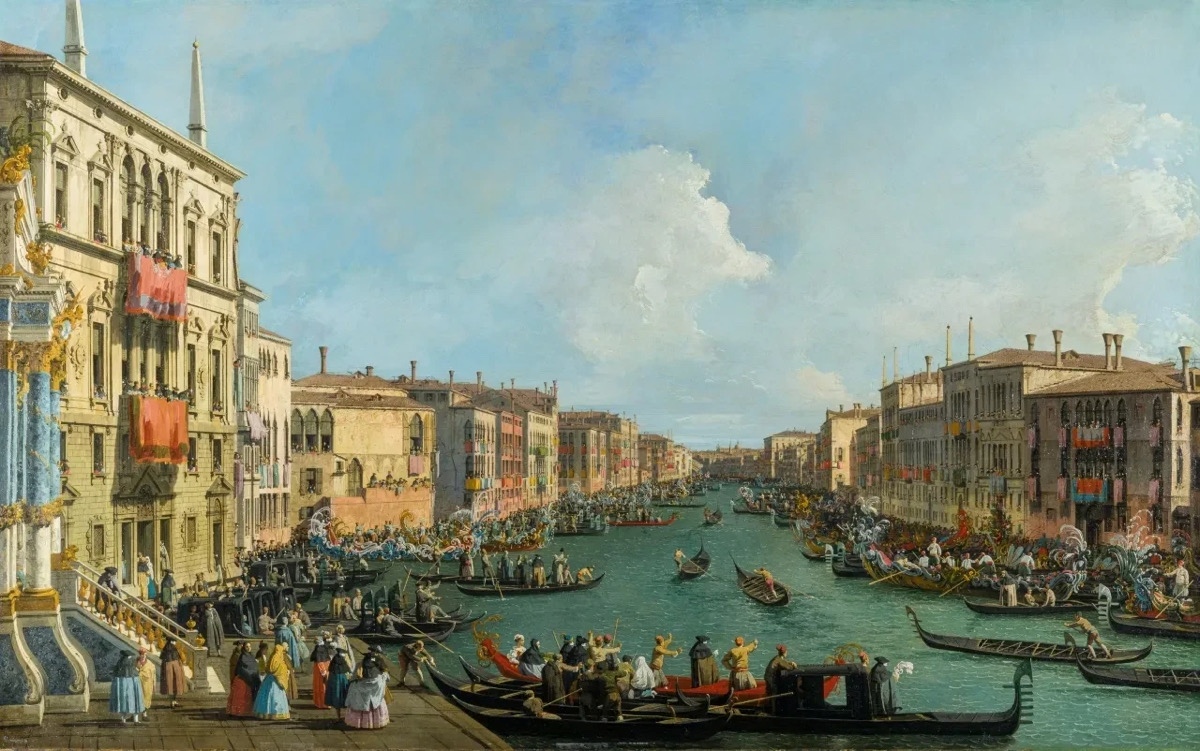
Seeing the city of Venice itself is also a great pleasure. The city where Rabindranath Tagore went in 1925. He called Venice the Queen of the Adriatic. Drawn by the beauty of the country and to complete some unfinished work, he went to Italy for the second and final time in 1926, though that time he did not go to Venice. 100 years after his trip to Italy, coming to Venice I felt as if I celebrated the days of Rabindranath’s Italian journey.
During the festival, on one hand I kept writing like a madman, on the other hand whenever I found a gap I wandered through the narrow lanes of Venice. I tried to understand their culture and traditions. I went to famous churches and basilicas. I was mesmerised seeing the works of famous painters of the Renaissance and the periods after it, mesmerised seeing them. I also got the opportunity to see contemporary artworks through the Biennale authorities. I was captivated seeing those works too. I thought, when the creative power of human beings embraces art and expresses itself, where does its limit stand? In infinity.
About this Biennale of Venice it can be said, “Within the limits, Infinite, you play your own melody.” I did not hear all of that melody. I mean, I only saw films and art exhibitions. All in all, I stayed in Venice from September 1 to 14, 14 days. I heard theatre performances were going on, musical events are ahead. So to see this vast, immense celebration of art, one would have to stay here for an entire year. That is not possible. So whatever little was seen, with that one can guess that they are setting the limit of artistic practice as high as the sky. Yet in Bangladesh, the boundaries of artistic practice are becoming smaller and smaller, now even if someone sings inside the house, the emotionally sensitive people rush in and stop that too. Kobigan is being stopped, theatre cannot be performed, watching films is haram and so on and so forth. For a frog in a well, it is actually impossible to understand the beauty and vastness of the universe. Trying to explain it is also foolishness!
While every developed nation in the world, alongside celebrating art for everyone, gives importance to its own history, heritage and culture and presents them, we are removing the pictures of the architects of independence, the undisputed leaders, and putting there the pictures of the enemies of the state of Bangladesh. This is happening in the University of Dhaka, the highest educational institution. Yet at this Biennale in Venice, among the crowd of other nation-states, I saw what a wonderful effort Italy makes to present its own distinctiveness. In every section of the film festival they have given place to quality Italian films. The same is true of the exhibition of artworks. Developed nations continue to spread their brilliance in this way, without making a fuss over settled matters. And a barbaric, uncivilised nation keeps smearing tar on its own face and sinking into the sewer.
Therefore, for the future generation, I am only leaving this written, as testimony, of where the world was moving, in which direction and at what speed, compared to how deep and deeper my country was sinking into darkness. Because of fanaticism, illiteracy, corruption and greed and lust, how an entire nation moves towards destruction, that is what I am trying to show by putting the progress of others in front. This is somewhat like loosely placing a long, sharp pencil beside a short, blunt pencil.
This write-up was first published in Prothom Alo on 17 September 2026 and has been translated from Bangla into English by Md Rabbi Islam.
Bidhan Rebeiro is the editor of Cut to Cinema.
Send your reviews, articles, and pitches for Cut to Cinema to [email protected]. Check out our submission guidelines for more details.

-20260223153409.jpg)