
Published: : December 4, 2025, 04:57 PM
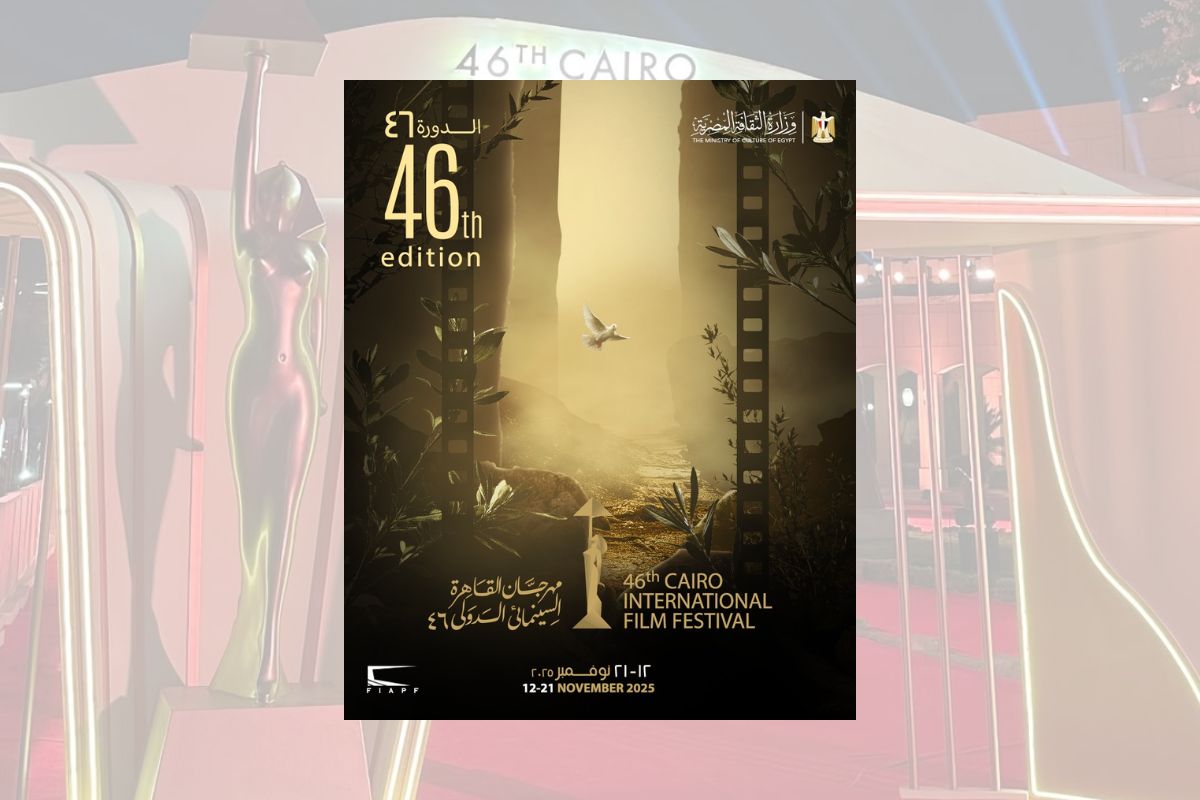
The 46th Cairo International Film Festival showcased a rebellious Arab cinema that is making its voice heard despite the crisis. The films revealed invisible social divisions and reflected a region in transition. In Cairo, culture proved its resilience.
Just as in literature, where Arab voices are becoming increasingly quiet in the Western world because they are published by ever smaller publishing houses and almost no one is willing to translate them anymore, the same is now true in cinema. The language of culture has been contaminated by the language of extreme politics. Everything must relate to conflicts that the audience prefers to see in black and white rather than in shades of grey. Arab films, it seems, have little chance on the international market. One might think they no longer exist.
But reality contradicts this as soon as you set foot in Cairo. There, where films are still allowed to speak before they are standardised to death by international distribution or ignored altogether. Even the cinema here knows more than society. It knows what society represses, what it loses, what it no longer wants to admit. And in a country like Egypt, whose lower classes and, increasingly, the middle class are being eroded by a brutal economic reality, which is losing its people to the Gulf states, which is trying to be both a modern megacity and a faceless crisis state, cinema sometimes knows too much.
At the same time, this very same Egypt is striving to revive its once legendary and now dying film industry, which in the 1950s still played in 359 cinemas across the country and today has to make do with just 60 remaining cinemas. The government has announced a programme that aims to do nothing less than rescue the studios of Cinema City, Al-Ahram and Al-Nahas from their structural agony. Modernisation, digitisation, even a new national film production – it all sounds like a renaissance that is to be both economic and symbolic. The big question remains whether the realities of politics, the market and artistic freedom can be reconciled. Many locals are sceptical, others are hopeful, and some just shrug their shoulders and turn to YouTube.
Perhaps that is why a programme series such as the retrospective of digitally restored classics seemed so significant. When works such as *Cairo 30* by Salah Abu Seif https://www.ciff.org.eg/itemmov/?id=1185693 or *The Man Who Lost His Shadow* by Kamal El Sheikh https://www.ciff.org.eg/itemmov/? id=1185726 shine in new technical clarity, it says less about nostalgia than about a country desperately trying to make its own past visible again before it disappears forever into the dust of the archives. And this look back at history seemed like a commentary on almost every current film at this festival: the present is fragile, full of cracks that are often barely noticeable – until cinema exposes them.
Central to this was the ‘Horizons of Arab Cinema’ section, which presented something like a collective portrait of a region that is both weary and resistant. Sarra Labidi’s *Looking for Ayda* https://www.ciff.org.eg/itemmov/?id=1151602, for example, an intimate film about call centre work, alienation and the deadly routine of modern gainful employment in the Global South, became a symbol of a society that wears people down without realising it. The camera remains mercilessly close to Ayda, whose face bears all the burdens without saying a word. The colleague who was fired describes his former job as ‘being buried alive’ – a phrase that echoes throughout the entire festival in all its facets, because so many films tell of this kind of death: through bureaucracy, through tradition, through poverty, through religious pressure, through disease, through political systems.
For right next to this individual, everyday suffocation stood *Pasha’s Girls* https://www.ciff.org.eg/itemmov/?id=1148223, an Egyptian social panorama of female precariousness. An employee is found dead in a beauty salon, presumably by suicide. But what is the focus? Not the woman’s life, but the salon’s reputation. A corpse washer refuses to wash the dead woman – religious and social logic weigh heavily on the body of the dead and even more heavily on the bodies of the women who remain. The self-empowerment that the film allows to shine through in some of the characters therefore seems less like emancipation than like writhing in the vice of a society that only ever sees women when they fall.
Arab and Tarzan Nasser already showed in Gaza mon amour (2021) that humour can become a survival strategy. In Once Upon a Time in Gaza (which, like the later-mentioned Baab, is running in other sections) https://www.ciff.org.eg/itemmov/?id=1148162 (a mixture of Gazawood self-irony and grim reality), they once again tighten the screws of black humour. People die as if in a Leone western, and between Hamas corruption and petty criminals, a bizarre Hamas propaganda film emerges. This is reminiscent of Sameh Zoabi’s TEL AVIV ON FIRE, but is far from being as well-rounded. The tone fluctuates, the narrative frays, but it is precisely this blurriness that makes the film a kind of desperate laughter on the brink of the abyss. A laughter that does not liberate, but rather reinforces the fact that normality in Gaza exists only as a farce.
This inability of the systems to perform even the simplest tasks is the focus of Yasser Shafiey’s Complaint No. 713317 https://www.ciff.org.eg/itemmov/?id=1154625, a bitterly comical – and therefore harrowing – look at a broken refrigerator. A retired couple loses itself for months in a quagmire of incompetent mechanics, an unstable power grid, government indifference, family alienation and male honour, which refuses to accept a new refrigerator bought with the wife’s money. The refrigerator becomes a symbol of the state, which not only fails to repair anything, but gradually crushes its citizens. Mahmoud Hemida, the Egyptian Robert De Niro, shines in every second of this film; his weary face tells us more about Egypt than any political speech.
Almost mirroring this is Ali Benjelloun’s *Goundafa: The Cursed Song* https://www.ciff.org.eg/itemmov/?id=1156198, which tells the story of a Moroccan village that falls apart under the influence of a conservative imam. Music is declared a sin, Amazigh identity https://en.wikipedia.org/wiki/Berbers becomes a problem, families break up, women fall silent. The film is melodramatic, sometimes lacking in explanation, but its images of loss are harrowing. The silencing of the women in the fields, the son who takes his own life after his instrument and his body are mutilated – all this seems like a variation on the same theme that *Ayda* and *Pasha’s Girls* also revolve around: people not only lose their freedom, they lose their voices.
Nayla Al Khaja’s *Baab* https://www.ciff.org.eg/itemmov/?id=1169101 adds a psychological dimension to this chorus. The first female director in the United Arab Emirates has made a film about grief, guilt and a woman who cannot comprehend the death of her twin sister. A character drama full of atmospheric disturbance, which in the end gets somewhat tangled up in symbolic loops and time shifts – a courageous failure, but one that clearly shows how much Arab societies are caught between tradition and the present. Between what cannot be said and what is constantly repeated in people’s minds.
Ali Saeed’s documentary *Anti-Cinema* https://www.ciff.org.eg/itemmov/?id=1170804, on the other hand, is a deeply moving documentary journey through Saudi Arabia, which officially had no cinemas for decades. The generation of the 1980s, which secretly projected, improvised and invented – all of this becomes an alternative film history that challenges the country’s official narrative. The bans following the 1979 terrorist attack on the Grand Mosque in Mecca https://en.wikipedia.org/wiki/Grand_Mosque_seizure, the makeshift festivals that were reclassified as ‘visual shows,’ the women who had to fight for the right to make films – Saeed shows a country that was never homogeneous, but always full of secret spaces and images of resistance.
This resistance culminated in *Round 13* https://www.ciff.org.eg/itemmov/?id=1154616, arguably the most emotionally direct film of the festival. The story of an ex-boxer whose son is suffering from cancer reflects the social impact of a Tunisia in which everyone is constantly in another, increasingly hopeless round. It is a film about poverty, about the silent torments of everyday life and about the lies parents tell to protect their children from the truth, even though the children already know everything. The eternal knockout from which one nevertheless picks oneself up again – a universal image that resonated particularly loudly in Cairo.
If you let all these films pass by again in a panoptic fast-forward, you get a panorama of contemporary Arab cinema that is not only aesthetically but also politically charged. Not didactic, not simplistic, but political in its finest narrative particles: in the loneliness of a call centre employee, in the dead body of a salon employee, in a pensioner’s refrigerator, in the silence of Amazigh women, in the secret cinema of Saudi youth, in the desperate gaze of a sick child. Everything is connected. Everything tells of the state of a region whose people often have more resilience than they themselves believe.
The 46th Cairo International Film Festival was therefore less a glamorous event than a state of affairs: a festival under pressure, under economic and political burdens, but precisely because of this, full of necessity. For it is here that images are created that anticipate the collective memory. It is here that voices unfold that hardly anyone in Europe hears anymore. Here, it becomes clear that Arab cinema is alive and well, with a tenacity that is both embarrassing and hopeful. And as long as it lives, there is room for hope – even if the fridge doesn’t work.