Published: : August 19, 2026, 05:23 PM
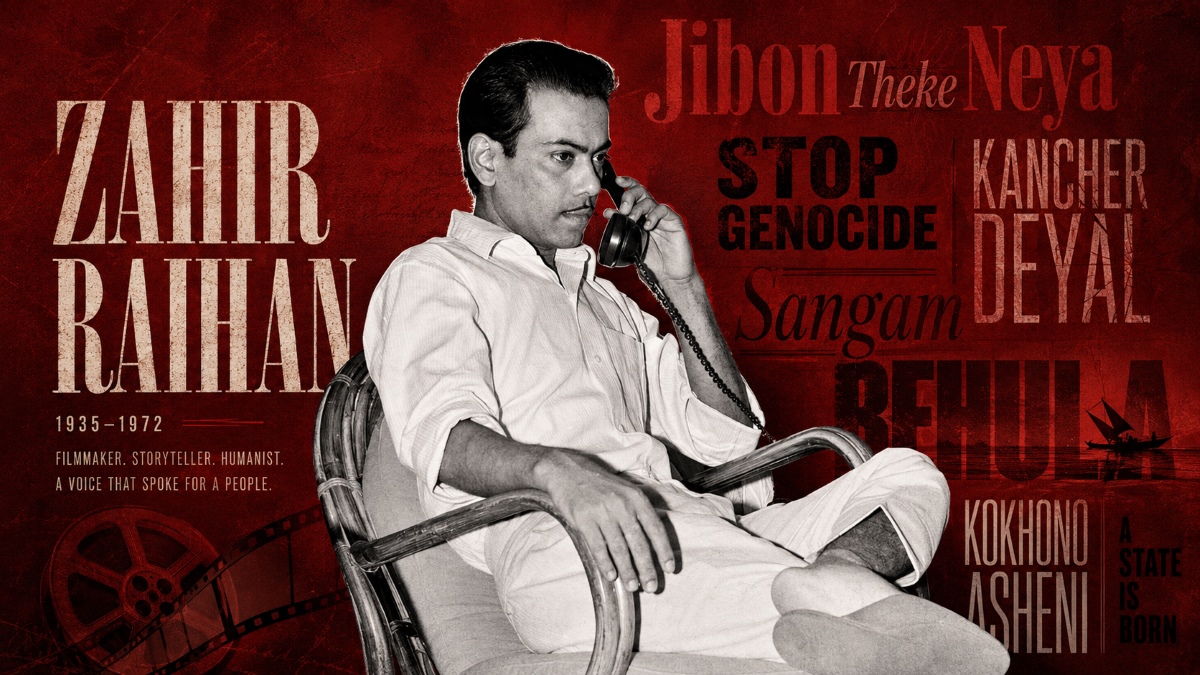
There are artists who record history, and there are artists who become part of it. Zahir Raihan belonged to the second kind. Born on 19 August 1935 in Majupur village of Feni, he became one of the major writers and filmmakers of twentieth-century Bengal. His life crossed the struggles that shaped Bangladesh: the Language Movement, the rise of Bengali political consciousness, resistance to authoritarian rule, and the Liberation War of 1971. Raihan did not separate artistic work from public responsibility. He wrote fiction, worked in journalism, studied photography, made films, and used documentary cinema to expose wartime atrocities. His importance lies not only in the range of his work but in the choices he made at decisive moments. He repeatedly chose participation over distance. His art came from the society around him, and when that society faced repression and war, his pen and camera became instruments of witness.
That commitment appeared early. Raihan studied at Dhaka College and later completed a BA Honours degree in Bangla at the University of Dhaka. As a young man he was drawn to the communist movement and, when party leaders were underground, carried messages for them. His political engagement was tested during the Language Movement. Banglapedia records that on 21 February 1952, despite restrictions on demonstrations, Raihan was among the first ten students to join a procession and was arrested. The Language Movement was therefore not simply a historical subject he adopted later as a writer. He had participated in it. The struggle over Bangla as a state language became part of his political formation, and its memory entered his literature. His novel Arek Falgun returned to the atmosphere of resistance created by 1952. In Raihan’s life, literature and politics developed from the same experience of cultural assertion and political defiance.
Before cinema made him widely known, Raihan had established himself in literature. His first story collection, Suryagrahan, appeared in the Bengali year 1362, and his works included Shesh Bikeler Maya, Hajar Bachhar Dhore, Arek Falgun, Baraf Gala Nadi and Ar Kata Din. These books explored social life, relationships, rural existence and political awakening. Hajar Bachhar Dhore earned the Adamjee Literature Award, while Raihan received the Bangla Academy Award in 1972. He was also associated with literary journals and was among the initiators of the English weekly Express in 1970. These facts matter because Raihan is often remembered mainly through Jibon Theke Neya and Stop Genocide. That picture is incomplete. He was a serious literary figure whose fiction addressed the tensions and aspirations of Bengali society before independence. His command of narrative, character and symbolism later strengthened his filmmaking, especially when he began translating political realities into cinematic form.
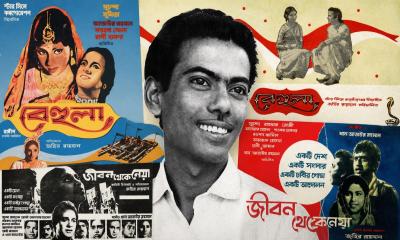
Raihan entered the film world in 1956 after studying photography in Calcutta. His first directed film, Kakhono Asheni, was released in 1961, followed by Kancher Deyal, Behula, Anwara, Sangam, Bahana and Jibon Theke Neya. Banglapedia identifies his Urdu film Sangam as the first colour film made in Pakistan, while Bahana was made in CinemaScope. These achievements show his interest in expanding the possibilities of filmmaking in an industry still developing in East Pakistan. Yet innovation for Raihan was not only technical. He understood cinema as a public language capable of carrying political meaning to a large audience. This combination reached its strongest form in Jibon Theke Neya, released in 1970. East Pakistan was then in intense political confrontation, and Raihan found a way to turn the experience of authoritarian rule into a story ordinary viewers could understand without sacrificing drama or artistic control.
Jibon Theke Neya is Raihan’s clearest political feature because it turns dictatorship into domestic experience. At its centre is a household controlled by an authoritarian woman whose domination of family members functions as an allegory for autocratic political rule. The film portrays Pakistan’s autocratic rule and reflects the growing resistance against the Pakistani authorities. It was released in the aftermath of the 1969 mass uprising and amid an intensifying Bengali movement for political rights. Raihan placed power inside a family, showing how control operates through fear, restriction and the denial of voice. The household becomes a miniature political order, while resistance within it echoes resistance outside. This gave the film unusual force: viewers could recognize political oppression through familiar human relationships. Jibon Theke Neya proved that popular cinema could carry serious political meaning without abandoning narrative appeal, and it established Raihan as a filmmaker able to transform the political crisis of his time into lasting cinematic language.
The Liberation War of 1971 removed the distance between representation and emergency. Raihan had begun an English-language film, Let There Be Light, but the war interrupted the project. After 25 March 1971, he went to Calcutta and turned to documentary filmmaking. Stop Genocide defined this period. Made while the war was continuing, the film documented violence by the Pakistan Army and the suffering of Bengali civilians and refugees. Research on Bangladesh’s war cinema notes that the provisional government sought documentaries that could inform international audiences and build support for the Bengali struggle. Stop Genocide placed that struggle within a wider language of anti-colonialism, war and human rights. Its importance also lies in timing: Raihan was not reconstructing atrocities years later. He was filming while events were unfolding, when evidence and international attention could matter immediately. In his hands, the camera became not only a medium of art but an instrument of testimony and political intervention.
The final chapter of Raihan’s life requires care because certainty ends where speculation begins. His elder brother, novelist and journalist Shahidullah Kaiser, was abducted in Dhaka in December 1971 during the killing of Bengali intellectuals. After independence, Raihan searched for him. On 30 January 1972 he went to Mirpur and never returned. That disappearance is established; the precise circumstances of his death are not. Different accounts have circulated, but they should not be presented as proven fact. What can be stated directly is powerful enough: weeks after Bangladesh achieved independence, one of the artists who had documented its war disappeared while searching for his missing brother. His absence became inseparable from the violence and uncertainty surrounding the country’s birth. Raihan was only thirty-six. The films he might have made in independent Bangladesh and the books he might have written remain possibilities history never allowed him to fulfil.
That unfinished life explains why Zahir Raihan commands attention decades later. His legacy does not rest on one film, novel or political act. It rests on his union of artistic ambition and civic responsibility. In 1952 he participated in the Language Movement and faced arrest. In literature he carried the memory of linguistic and social struggle into fiction. In cinema he experimented with technology while transforming authoritarianism into political allegory. In 1971 he left an unfinished feature and made documentaries about a war whose outcome was not yet certain. These facts need no romantic exaggeration. Together they reveal the character of his life. On his birthday, the best tribute is not to turn Zahir Raihan into a distant icon, but to remember the standard his work set: an artist must look closely at his time, tell the truth as clearly as his medium allows, and refuse the comfort of silence when history demands a voice.
Md Rabbi Islam is a sub-editor of Cut to Cinema. He can be reached at [email protected].
Send your reviews, articles, and pitches for Cut to Cinema to [email protected]. Check out our submission guidelines for more details.