
Bidhan Rebeiro, Translated by Md Rabbi Islam
Published: : August 19, 2026, 01:35 AM
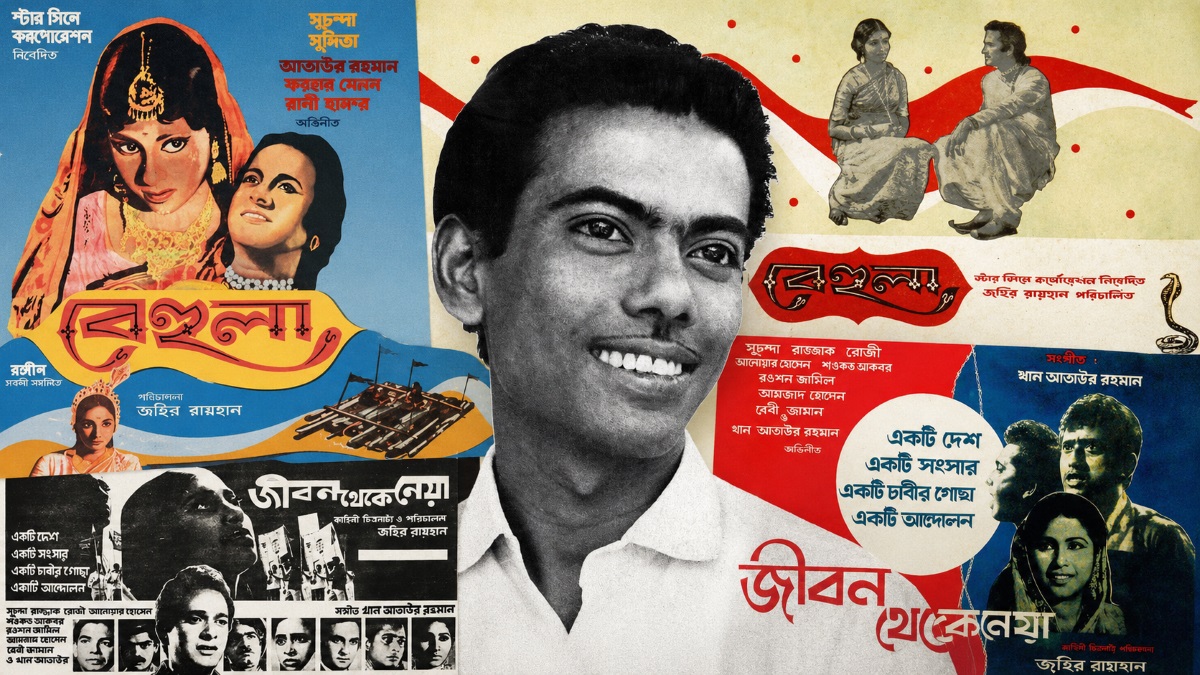
“From among many kinds of work, an intellectual has to find such a work that he can do skilfully, beautifully. Once the battlefield of work has been determined, then the next task is to find the enemy’s power-base in that battlefield and determine the strategy for striking there.” — Solanas and Getino (1971: 47)
April 1971. He was secretly helping the freedom fighters. But he was not satisfied. So he said to his elder brother Shahidullah Kaiser, “Borda, I will leave. I will not be able to do anything by staying here. This time I will put my dream to work. The history of our struggle has to be captured on camera. All this time I have only handled the camera. Now the day has come, I must put my camera to work for the people.” (Panna Kaiser, cited by Anupam Hayat 2007: 43)
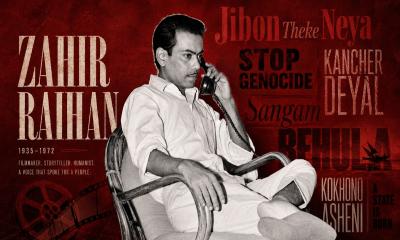
After that Zahir Raihan went to Kolkata. There, between June and August, he made Bangladesh’s first documentary on the Liberation War, ‘Stop Genocide’. He used to write stories, wrote novels, and also worked as a journalist. By that consideration he was an intellectual. As Solanas and Getino said— from among many kinds of work an intellectual has to choose one work with which to fight, the work in which he will be the most adept person. Zahir Raihan left his other works behind and made cinema his companion. On that very battlefield he composed the struggle for liberation. He placed the Liberation War of Bangladesh and the barbarity of West Pakistan alongside international events. At the end of the day or ultimately he showed Yahya in the ranks of Hitler, Mussolini. He placed the genocide in Bangladesh beside Vietnam. He expressed his hatred of imperialism in Lenin’s voice.
With his camera Raihan once went to the battlefield on the Bangladesh border and to the processions of helpless people leaving the country, then returned again to the training centres and refugee camps in India. In ‘71 he was truly a guerrilla. What Argentina’s guerrilla filmmakers had envisioned, the outline of Third Cinema that they had presented, in Bangladesh Zahir Raihan was an embodiment of all of that. Activists of the Third Cinema movement believe, neither a revolutionary government nor a favourable environment is needed to make revolutionary films. Even amid a hundred adversities and limitations, it is possible to make films capable of inspiring. The idea of Third Cinema that emerged from the tide of revolution in Latin America. A Third Cinema filmmaker means a guerrilla fighter. Who is a guerrilla fighter? One who wants a change in the social system. One who, unable to endure the humiliation and poverty of the people of his own country, takes up arms. One who is himself an awakened teacher against the instigator (Guevara 1960: 66) To give a forceful reply to the injustice and oppression inflicted upon the people of Bangladesh, the Bengalis and indigenous people of this country had taken up lethal weapons, Zahir Raihan also joined them, his weapon was the camera. In the struggle to change society with a gun or a camera in hand both are guerrillas. The guerrilla fighter and the guerrilla filmmaker therefore became synonymous in Latin America. In Bangladesh too guerrilla Zahir Raihan showed in ‘71, it is possible to wage war with a camera in hand.
The idea of considering Zahir Raihan’s films as bullets and the camera as a firearm did not develop in a single day. Raihan had been involved in various political movements and struggles from his youth. In the Language Movement of ‘52, Zahir Raihan was one of the first group of ten people in Dhaka who violated Section 144. From ‘58 to ‘70, he continued various political activities openly and secretly. Under the leadership of Comrade Moni Singh Raihan worked with the Communist Party and its affiliated organisations. With a camera in hand he was active at the Peasants’ Association gathering held in Dhaka in ‘69.
When the manifesto of Third or Guerrilla Cinema was declaring that one had to come out of the style, distribution and marketing processes of Hollywood cinema, otherwise it would not be possible to stand against imperialism, nearly six years before that, at the Pakistan Film Festival held in Dhaka in 1965 Raihan was saying, “ ... it has been proclaimed loudly that the star system is a weapon for capitalists to hunt profits. Money-greedy businessmen have imported this system from the American land. Abolish this system and foil the imperialists’ sinister conspiracy. Create a spirit of collective work.” (Hayat 2007: 30)
It was to rebuke the brutal genocide committed by West Pakistan, the ally of that American imperialism, that Raihan made ‘Stop Genocide’. We witness this rebuke when American warplanes indiscriminately drop bombs on Vietnam, when the oppression of West Pakistan’s military junta pursues children-the elderly-women, when humanity is assaulted by the beastly behaviour of human beings. At the end of every injustice and oppression Raihan cries out ‘Stop’. This rebuke to stop then turns into a call of world humanity. In this film the national liberation movement rises to the larger struggle of humanity. In the other countries of the world where people are fighting and struggling against imperialism, this film becomes their voice as well. Revolutionary leader Lenin had already calculated that the national liberation movement holds the potential to accumulate immense strength against capitalism and imperialism. (Lenin, cited by Dobar 1972: 220) We have seen examples of that accumulation of strength in Latin America. But it was not seen in Bangladesh. Why it was not seen is a different discussion.
Anyway, in Kolkata Zahir Raihan had the opportunity to see a handful of films, including films by Andrzej Wajda, Santiago Álvarez. In particular Cuban director Álvarez’s film ‘Hasta la Victoria Siempre’ (1967) greatly influenced Raihan. Using whatever was at hand, just as Álvarez had made ‘Hasta la Victoria Siempre’ at the editing table, Zahir Raihan similarly made ‘Stop Genocide’. Álvarez’s film, made in only 48 hours, was screened at the public meeting where Fidel Castro announced the news of revolutionary Che Guevara’s death. (Lihai 2002: 2) Álvarez made the film specifically for Che’s passing.
The touch of the tide of guerrilla cinema that came to Latin America in the sixties and seventies can be seen in Zahir Raihan’s hands in ‘71. At the same time three more films were made centred on the movements for independence and liberation. Of these Zahir Raihan directed the film ‘A State Is Born’. And he was the producer of the other two films (‘Liberation Fighters’ directed by Alamgir Kabir and ‘Innocent Millions’ directed by Babul Choudhury). Made by dividing into small groups, these small films became at that time the only vehicles for spreading the truth. It is no exaggeration to say, Zahir Raihan served as the imam of these films.
Alamgir Kabir was a collaborator in Raihan’s making of these guerrilla films. Toward the end of November ‘71, “on the eve of victory in the Liberation War two film units were formed under the leadership of Zahir Raihan. One was led by Zahir Raihan and the other was led by Alamgir Kabir. In the Eastern Sector comprising Dhaka-Mymensingh Zahir Raihan captured on camera images of the barbarity of the Pakistani army and the operations of the Allied Forces.” (Alamgir Kabir, cited by Hayat 2007: 45)
When Zahir Raihan entered the independent country from Kolkata on 18 December, even then with a camera in hand, like a devoted film worker, he took pictures of the jubilation of victory. Panna Kaiser, wife of his elder brother Shahidullah Kaiser, says from memory, “He keeps working like a madman for the camera. He completely forgot that at home his Borda-mother-brothers-sisters were waiting for him.” (Hayat 2007: 46) It was at exactly that time Zahir Raihan learned, his elder brother had been missing since 14 December. A new struggle began. He threw himself into trying to uncover the network behind the killing of the intellectuals. “He collected the names of many collaborators of the occupation forces, held the government responsible for the killing of the intellectuals. Calling a press conference he announced that, he would publish a white paper and would also disclose many secret details of the Mujibnagar government.” (Shahriar Kabir, cited by Hayat 46-47) Who knows perhaps this guerrilla filmmaker had to pay the price for those activities and threats. After receiving an anonymous phone call, on 30 January 1972 he rushed to Mirpur in search of his missing elder brother Shahidullah Kaiser. Mirpur was a Bihari-dominated area of allies of the Pakistani soldiers. It is said that Raihan lost his life that day in their armed attack. The allies of West Pakistan also made his body disappear. However if the matter of the anonymous phone call is taken into account, Raihan’s death or disappearance remains shrouded in mystery.
It was unfortunate that Raihan left just when Bangladesh’s film industry was preparing to move forward holding Raihan’s hand. Among his most capable collaborators Alamgir Kabir made some films afterwards but those were a thousand miles away from the philosophy of guerrilla cinema. Regrettably after independence, neither the favourable environment and collaborators nor anyone else ever walked that path again. Therefore it can be said, the Third Cinema movement came to this land holding Zahir Raihan’s hand and again left holding his hand. No one else in Bangladesh became a guerrilla filmmaker with a vow to change society. But can it be said under oath that no one is nurturing that dream?
Note: This article was translated from Bangla into English from Bidhan Rebeiro’s book (A Guide: How to Read Film, 2011).
Bidhan Rebeiro is the editor of Cut to Cinema.
Send your reviews, articles, and pitches for Cut to Cinema to [email protected]. Check out our submission guidelines for more details.