
Published: : August 21, 2026, 12:16 PM
“Gather ye rosebuds while ye may,
Old Time is still a-flying;
And this same flower that smiles today
Tomorrow will be dying.”
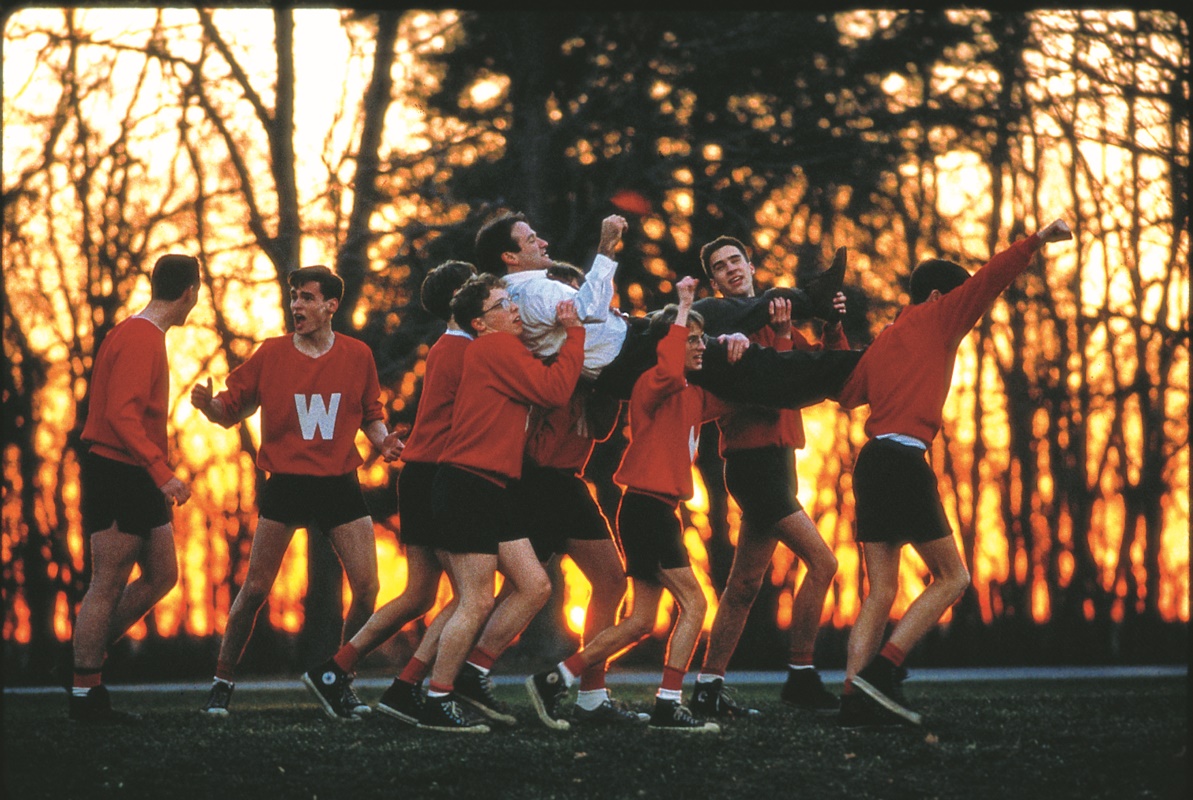
There is a moment near the beginning of Dead Poets Society that has always stayed with me. John Keating takes his students out of the classroom and asks them to look at old photographs of boys who once studied at Welton Academy. Those boys had plans, ambitions, and futures they probably thought were still far ahead of them. Then Keating leans toward his students and quietly says, “Carpe diem.” Seize the day. It has become one of the most famous lines from the film, almost a motivational slogan, but the scene itself feels much darker than that. Keating is standing in front of photographs of boys who are now dead. His message is not simply that life should be exciting or adventurous. He is reminding his students that time is moving whether they are ready for it or not.
That is one of the reasons Dead Poets Society still feels powerful. It is easy to remember the film as an inspiring story about individuality and following your dreams. Keating encourages his students to stand on desks, tear pages from a textbook, read poetry aloud, question what they have been taught, and look at life differently. But the film becomes much more interesting when it shows that finding your own voice is not the same as being free to use it. These boys are still teenagers. Their parents, teachers, and school have enormous control over their lives, and that makes the idea of simply “following your heart” much more complicated.
Welton Academy is the perfect place for this conflict. Its values are “tradition, honor, discipline, excellence.” None of those words sounds wrong, but inside Welton they become something restrictive. The boys are expected to succeed in very specific ways. They should get good grades, attend respected universities, enter respectable professions, and make their families proud. Their futures are almost decided before they are old enough to decide anything for themselves. The problem is not that the adults around them want them to succeed. The problem is that the adults are so certain about what success should look like that the boys’ own wishes begin to seem unimportant.
Keating challenges that way of thinking. Robin Williams plays him with more restraint than people sometimes remember. He is funny and theatrical, but he is not simply a teacher who gives dramatic speeches. What makes him different is that he treats his students as people who are capable of having their own thoughts, fears, and desires. He does not just teach them poetry. He pushes them to question the idea that their lives have already been planned for them.
Todd Anderson is probably the clearest example of what Keating changes. Todd arrives at Welton already living in the shadow of his successful older brother. He is painfully shy and seems uncomfortable even when someone notices him. Ethan Hawke plays him like someone who is constantly afraid of saying the wrong thing. Todd does not seem to believe that anything he says will be worth hearing. That is why the poetry exercise is such an important scene. Keating makes Todd stand in front of the class and improvise. At first, Todd is terrified. He stammers, hesitates, and tries to escape the situation. Then something changes. He begins speaking without thinking about whether every sentence is good enough. What makes the scene work is that Keating does not magically give Todd a voice. Todd already has one. He has simply spent so much time hiding it that speaking honestly feels almost impossible.
Neil Perry’s story is much more painful because he seems, at first, like Todd’s opposite. Neil is intelligent, popular, energetic, and confident around his friends. But whenever his father appears, that confidence disappears almost instantly. Mr. Perry has already decided what Neil’s future will be. Neil will become a doctor. There is no real discussion about it because, in his father's mind, the decision has already been made. Then Neil discovers acting. He earns the role of Puck in A Midsummer Night’s Dream, and for the first time we see him doing something that seems completely his. Acting is not something Welton chose for him. It is not something his father planned. It is simply something Neil loves.
That is why his father’s reaction is so painful. Mr. Perry does not see himself as cruel. He believes he is protecting his son from making a foolish decision. In a way, that makes him more believable and more frightening. Neil is not being controlled by someone who openly hates him. He is being controlled by someone who is convinced that control is a form of care. Around his friends, Neil is lively and expressive. Around his father, he becomes smaller. He starts sentences and gives up on them. He knows what he wants, but he has never learned how to say it to the person who has the most power over his life.
This is also where Keating’s “carpe diem” philosophy becomes more complicated. It is easy to tell someone to seize the day when that person has the freedom to make their own choices. Neil does not. He is still financially dependent on his parents, controlled by his school, afraid of his father, and expected to obey. Keating helps him understand that his own desires matter, but understanding that does not suddenly make him independent. That is one of the film's most painful ideas. Sometimes realizing what you want can make life harder when you have no real power to choose it. As the review originally puts it, inspiration can awaken someone, but awakening inside a life you cannot control can also be painful.
Neil performs in the play anyway, and onstage he looks completely alive. For a short time, he gets to be the version of himself that he wants to be. Then his father appears, and the happiness disappears almost immediately. Neil is taken home and told that he will leave Welton, attend military school, and continue toward the medical career already chosen for him. Later that night, Neil dies by suicide. At that point, the film can no longer be viewed as a simple celebration of following your dreams. The inspirational message suddenly feels incomplete. Everyone begins searching for someone to blame, and Keating becomes the easiest answer. Welton blames him, Mr. Perry blames him, and the institution gets to avoid asking harder questions about how Neil ended up feeling so trapped.
This is also where I think the film deserves some criticism. Welton is sometimes presented as almost too rigid, while Keating is presented as unusually understanding and humane. Real families, schools, and teachers are usually more complicated than that. Keating's ideas also deserve more questioning than the film sometimes gives them. Encouraging teenagers to think for themselves is important, but it is not enough to simply tell them to be brave. What happens when their choices clash with family authority, money, fear, or dependence? Neil does not only need someone to tell him that his dreams matter. He needs someone to help him deal with what might happen after he tries to follow them. That is a much harder problem, and the film never completely solves it.
The final scene with Todd is powerful because it gives us a different kind of rebellion. Keating has been dismissed and returns to the classroom to collect his belongings. Todd tries to explain that the students were pressured into signing a statement against him, but Headmaster Nolan orders him to sit down. Instead, Todd climbs onto his desk and says, “O Captain! My Captain!” A few other boys follow him. Some do not. I actually think the scene is stronger because not everyone stands. If the whole class had risen together, the moment might have felt too neat, almost like a complete victory. But nothing has really been fixed. Keating is still leaving. Neil is still dead. Welton has not changed. Fear is still there. And yet Todd stands anyway.
That moment means even more because of what happened earlier in the film. At the beginning, Keating made the boys stand on their desks so they could look at the world from a different perspective. Back then, Todd was simply following instructions. At the end, no one tells him to stand. In fact, an authority figure is ordering him to sit down. The first time he stands on the desk, it is an exercise. The second time, it is his own decision. That difference says almost everything the film is trying to say about finding a voice.
For me, that is why Dead Poets Society is more than a film about “seizing the day.” Its real strength is in showing how difficult it can be to claim ownership of your own life. The film can be sentimental, romantic, and sometimes very obvious about wanting an emotional reaction from the audience, but beneath all of that is something painfully real. Many people are never directly told that their dreams are worthless. Instead, they hear things that sound reasonable: be sensible, choose something secure, do not disappoint your family, make everyone proud, and maybe do what you love later. The danger is that later can quietly become never.
Keating cannot protect his students from that reality, and the film never suggests that he truly can. What he gives them is something smaller but still important: the idea that their own voices deserve to be heard. Neil discovers that idea in a life where he has almost no freedom to act on it. Todd discovers it too, but by the end of the film he manages to act on it, even if only for a moment. That is why “carpe diem” feels different by the time the credits arrive. It is no longer just a cheerful message about living boldly. It becomes a warning about how easily other people can arrange your life while you keep waiting for permission to begin living it yourself.
In the end, the moment I remember most is not Keating telling the boys to seize the day. It is Todd standing on his desk while he is being ordered to sit down. “O Captain! My Captain!” he says. Earlier in the film, Todd could barely speak in front of his classmates. Now he chooses his own words in front of the people who expect him to remain silent. Keating still has to leave, and Todd’s act does not suddenly change Welton, but that is not really the point. For once, Todd is not speaking because someone told him what to say. He is speaking because he has decided that staying silent would be worse. And for me, that small act of courage is what makes Dead Poets Society stay with you long after the film ends.
Md Rabbi Islam is a sub-editor of Cut to Cinema. He can be reached at [email protected].
Send your reviews, articles, and pitches for Cut to Cinema to [email protected]. Check out our submission guidelines for more details.